Germany's Wealth Tax – Is It Coming Back? Parties, Studies and Lessons From Abroad
According to a poll for German public broadcaster ARD, 64% of Germans support a wealth tax, and several motions are pending in the Bundestag. I show you neutrally where the 10 largest parties stand, what studies say about revenue and avoidance (including who paid for them), what other countries have experienced – and at the very end, clearly labelled, my own opinion.
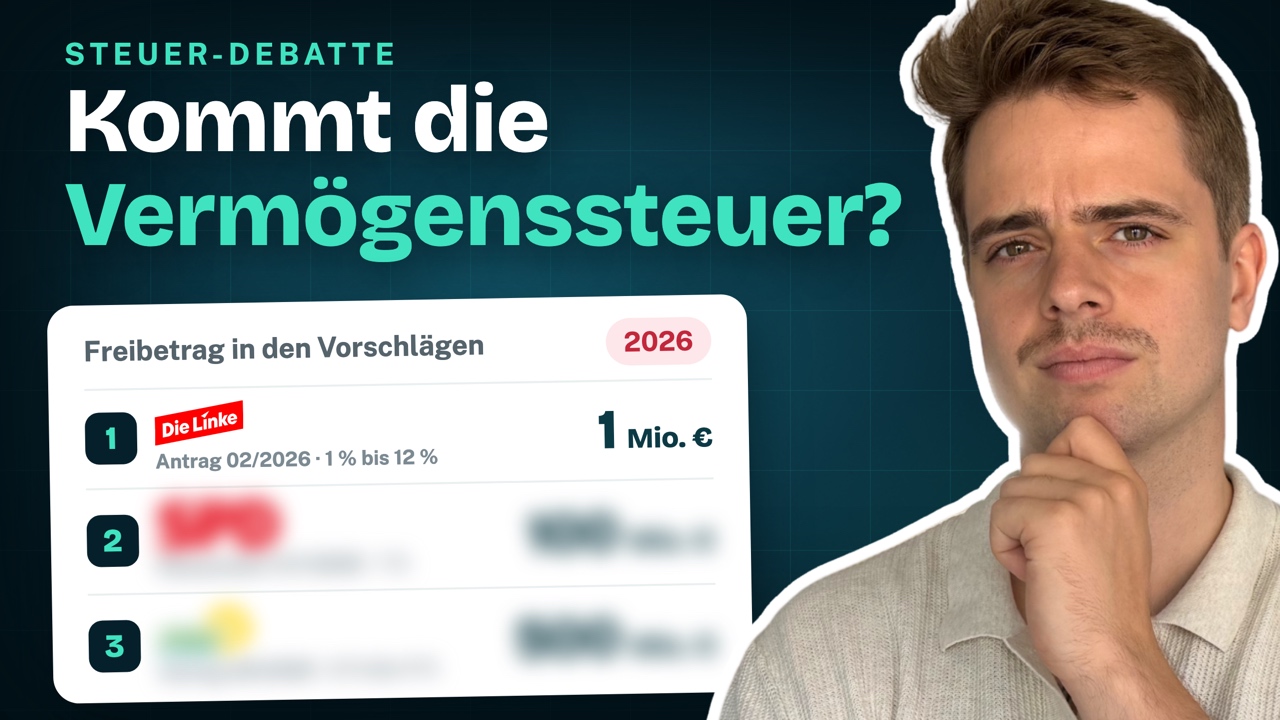
Table of contents
- The status quo: it still exists – on paper
- What happened in the Bundestag in 2026
- Video
- The 10 largest parties at a glance
- Who else is for and against it
- The right account: Smartbroker+ with a €20 McDonald's share
- The case for it: wealth is very unequally distributed
- How much money would a wealth tax raise?
- The fears: what speaks against a wealth tax
- Ideas and variants: not every wealth tax is the same
- Other countries: who still has it and what happened?
- Is it coming back? The summary
- For and against
- My opinion: I'm against a wealth tax
- FAQ
Hardly any tax topic in Germany is debated as emotionally as the wealth tax. According to an April 2026 poll by infratest dimap for the public broadcaster ARD, 64% of Germans are in favour, 29% against. At the same time, even a DIW study commissioned by Die Linke's parliamentary group and the Rosa Luxemburg Foundation expects that, under Die Linke's model, up to 80% of the hoped-for revenue could be lost to avoidance. So what's true?
In this article we look at the German wealth tax as neutrally as possible: what applies today, what happened in the Bundestag in 2026, where the 10 largest parties stand, what studies say about revenue and risks – and what other countries have experienced. For every study I tell you who paid for it, because many of them are commissioned work. My own opinion only comes at the very end, in a separate, clearly labelled section.
As always, the most important thing first: this is not tax, legal or investment advice. All information is as of the end of October 2026 – the debate is ongoing and things can change quickly. Links marked with * are referral links: if you use them, I receive a small commission, at no extra cost to you.
The status quo: it still exists – on paper
Many people don't know this: Germany's Wealth Tax Act still exists. It is still federal law and was last amended in 2001 (gesetze-im-internet.de). In April 2026, the AfD parliamentary group even moved to formally repeal it, because it still "formally exists" (Bundestag printed paper 21/5486). But the tax has not been levied since 1997.
The reason is a decision by the Federal Constitutional Court of 22 June 1995 (2 BvL 37/91). The court objected that real estate was valued at "standard values" that had not been updated since 1964/74, while other assets counted at current values – and both were taxed at the same rate. That violated the principle of equality. Lawmakers would have had to pass new rules by 31 December 1996. They never did.
Important: the court did not ban the wealth tax in principle. One guiding principle from the decision is still debated today, though – the so-called half-share principle (Halbteilungsgrundsatz): the total tax burden on the expected return of an asset should remain close to an equal split between the private and the public sector. Justice Ernst-Wolfgang Böckenförde already disagreed in a dissenting opinion at the time, writing that the Basic Law contains no constitutional law of the wealth tax. Whether a new wealth tax would have to respect this limit is disputed among legal scholars.
This is what the old tax last looked like (Sections 6 and 10 of the Wealth Tax Act):
- 1% on the wealth of individuals
- 0.5% on business assets and agricultural and forestry assets
- 0.6% for corporations such as a GmbH or AG
- allowance of 120,000 Deutschmarks per person, i.e. around €61,355
According to DIW economists (in a publication by the trade-union-affiliated Hans Böckler Foundation), it raised around 9 billion Deutschmarks in its last year, 1996 – around €4.6 billion. For the last main assessment in 1995, the DIW cites around 0.9 million taxpayers. And one detail that often gets lost in the debate: the money goes to the federal states, not the federal government (Art. 106(2) Basic Law). A wealth tax would therefore not directly plug gaps in the federal budget.
By the way, the word "Vermögensteuer" (wealth tax) does not appear even once in the 2025 coalition agreement between the CDU, CSU and SPD.
What happened in the Bundestag in 2026
Even though the coalition agreed nothing, the wealth tax was more present in the Bundestag in 2026 than it had been for a long time:
| Date | What happened |
|---|---|
| 6 Feb 2026 | Die Linke moves to reinstate the wealth tax: 1% from €1 million, rising linearly to 5% from €50 million, 12% from €1 billion (printed paper 21/4029) |
| 6 Mar 2026 | First reading, referral to the Finance Committee (Bundestag) |
| 21/23 Apr 2026 | The AfD moves for the opposite: to abolish the Wealth Tax Act entirely, first reading on 23 April |
| 18 Jul 2026 | SPD general secretary Tim Klüssendorf calls the wealth tax a "key issue" in an interview with the NOZ newspaper: it is about one percent a year on wealth above €100 million (Presseportal) |
| 29 Sep 2026 | The Greens propose a "€500 million tax" on "extreme wealth": allowance of €500 million, rates of 2 to 4%, according to the motion "more than 20 billion euros" a year (printed paper 21/8267) |
| 6 Oct 2026 | The SPD parliamentary group calls for the "reinstatement of the wealth tax" in a position paper (Handelsblatt) |
| 7 Oct 2026 | The Finance Committee rejects Die Linke's motion – with the votes of the CDU/CSU, AfD, SPD and Greens (printed paper 21/8481) |
The last point surprises many: why would the SPD and the Greens vote against a wealth tax motion when they want one themselves? According to the committee's recommendation, the SPD shares the motion's basic concern but considers its specific design insufficient, and points to "different positions within the coalition". The Greens justified their no with avoidance and emigration effects at a rate of 12% and the administrative burden – and pointed to their own €500 million model. The Union called the wealth tax "the wrong signal", the AfD warned it could drain liquidity from companies.
Status at the end of October 2026 in one sentence: there is no bill from the federal government or the coalition, only opposition motions and SPD position papers – and the Union is against it.
Video: Germany's Wealth Tax – Is It Coming Back? Parties, Studies and Lessons From Abroad
This whole topic is also available as a video (in German) – with all the parties, studies and countries. Feel free to watch, or read on below.
The 10 largest parties at a glance
For this overview, I took the 10 parties with the most second votes in the federal election on 23 February 2025 (Federal Returning Officer) and read their manifestos. I added Volt (11th place) as a bonus.
| Party | Result 2025 | Position | Model | From the 2025 manifesto (own translation) |
|---|---|---|---|---|
| CDU | 22.6% | against | – | "No wealth tax. We don't want to punish people who have worked for and built something. … We reject a wealth tax." (p. 32) |
| AfD | 20.8% | against, wants to abolish the law | – | "The AfD wants to abolish the wealth tax, which is currently suspended, as well as inheritance tax." (p. 60) |
| SPD | 16.4% | in favour (very large fortunes) | no figures in the manifesto; Klüssendorf: 1% from €100m | "We want to revitalise the suspended wealth tax for very large fortunes." (p. 19) |
| Greens | 11.6% | in favour (only "extreme wealth") | motion 2026: allowance €500m, 2% / 3% from €1bn / 4% from €10bn | "Possible approaches include: a global billionaire tax, … and a national wealth tax on very large fortunes." (p. 73) |
| Die Linke | 8.8% | in favour (core demand) | allowance €1m (+€5m business assets), 1% to 5%, 12% from €1bn | "Die Linke demands that the wealth tax be reintroduced." (p. 10) |
| CSU | 6.0% | against | – | joint manifesto with the CDU (p. 32) |
| BSW | 4.98% | in favour (from €25m) | 1% from €25m, 2% from €100m, 3% from €1bn | "We want to reactivate the wealth tax for assets of €25 million or more at a rate of 1 percent …" (PDF p. 17) |
| FDP | 4.3% | against | – | "We reject any form of wealth tax or wealth levy." (p. 13) |
| Free Voters | 1.5% | no explicit statement | – | Nothing on the wealth tax in the manifesto. On inheritance tax: "We are aiming … for the abolition of inheritance and gift tax." (p. 36) |
| Animal Protection Party | 1.0% | in favour (no model) | no figures | "Anyone who has accumulated wealth of many millions or billions … these mountains of money should be taxed fairly." (section "Wealth tax", p. 16) |
| Volt (bonus) | 0.7% | in favour (progressive) | allowance of a "multi-million amount" per person | "A multi-million amount per person applies as an allowance." (p. 100–101) |
Quotes from the manifestos for the 2025 federal election, translated from German; page numbers as in the PDF. The CDU and CSU had a joint manifesto ("Politikwechsel für Deutschland"). The SPD and Green models don't come from the manifestos but from an interview (SPD) and a Bundestag motion (Greens).
Adding it up: in favour are the SPD, Greens, Die Linke, BSW and the Animal Protection Party (plus Volt). Against are the CDU, CSU, AfD and FDP. The Free Voters make no explicit statement. What stands out is how far apart the supporters' allowances are: from €1 million for Die Linke to €500 million for the Greens. So "wealth tax" isn't always the same "wealth tax" – we'll come back to that.
Who else is for and against it
Outside the parties, the camps are clearly divided too. In favour are mainly the trade unions. Together with the German Trade Union Confederation DGB, the services union ver.di calls for a wealth tax above an allowance of one million euros per person, with rates from 1% up to 2% for wealth above €1 billion (ver.di). DGB head Yasmin Fahimi additionally argues for a wealth levy that would "make no one poor" (ZDFheute). An infratest dimap poll commissioned by ver.di found 81% approval – but among ver.di members, not the general population.
Against are mainly business and taxpayer associations. The family business association Die Familienunternehmer, the Taxpayers' Association (Bund der Steuerzahler) and more than 20 other associations launched the campaign "Wealth tax hits everyone" back in 2021 (Bund der Steuerzahler). Their main argument: a wealth tax would hit not only the super-rich but also businesses, the self-employed and savers.
And the population? In the infratest dimap poll for ARD mentioned at the start (7 to 14 April 2026, 2,084 respondents aged 16 and over), 64% were in favour of introducing a wealth tax and 29% against (hessenschau). The exact wording of the question was not published. That matters, because whether someone is "in favour" depends a lot on whether they're thinking of an allowance of €1 million or €100 million.
The right account: Smartbroker+ with a €20 McDonald's share
However the debate ends: the best way to build wealth is over the long term and at low cost. I use Smartbroker+, among others, and currently have my own partner promotion there: if you open a free account as a new customer through my link*, you get a McDonald's share worth €20 (WKN 856958) for free.
According to the promotion page (as of 26 October 2026), Smartbroker+ lets you trade stocks, ETFs and funds from €0 (from €500 order volume via gettex, plus usual market spreads, inducements and product costs), offers more than 4,600 savings plans with €0 order fees, and order processing runs through German institutions. How the promotion works and what to watch out for so the share actually reaches you is explained in my article on the Smartbroker+ promotion. You'll find the full terms of participation on the promotion page – best read them right before you sign up.
The case for it: wealth is very unequally distributed
The supporters' most important argument is distribution. According to the Bundesbank household wealth survey (2023 data, published in April 2025), the richest 10% of households own 54% of total net wealth. The Gini coefficient, a measure of inequality from 0 (everyone has the same) to 100 (one person has everything), stands at 72.4 for wealth (Bundesbank). For disposable income it's only around 30 (2025: 30.1, Statistical Offices). So wealth is more than twice as unequally distributed as income. The median household owns €103,200, while the average is €324,800 – which also shows how strongly a few large fortunes pull the average up.
The Bundesbank survey hardly captures the super-rich, though, so the 54% is more of a lower bound. In its 2026 study (commissioned by Die Linke's parliamentary group and the Rosa Luxemburg Foundation), the DIW adds rich lists and finds that the richest 1% – starting at personal wealth of €2.3 million – own a good third of all wealth, and the richest 10% a good two thirds (DIW).
To be fair, though: pension entitlements don't count as wealth in these statistics. If you roughly include statutory pension entitlements, the wealth Gini falls from 72 to around 58, according to the Bundesbank.
The second argument: wealth is taxed lightly in Germany by international standards. According to OECD statistics, property-related taxes amounted to 0.91% of GDP in 2023, compared with an OECD average of 1.68%. But the gap comes mainly from the low property tax (0.37% vs. 0.95%) – which tenants also pay through their service charges. Even the DIW writes that this is only to a small extent due to the wealth tax no longer being levied. On inheritance tax, Germany is actually above the OECD average at 0.23% of GDP vs. 0.15%.
And the third argument concerns administration. Critics often say a wealth tax costs almost as much as it raises. The DIW, by contrast, estimates the collection costs of a modern, properly valued wealth tax at 4.4 to 8.2% of revenue (2016 study commissioned by the SPD-affiliated Friedrich Ebert Foundation) and 3.2% for Die Linke's high-revenue model (2026) – roughly on a par with income tax, it says. For the old tax of the 1990s, estimates compiled by the Academic Advisory Board at the Federal Ministry of Finance in 2013 give much higher figures of over 30%, according to a statement for the Bundestag. One reason: revenue was small back then, but the cost of valuation was not.
How much money would a wealth tax raise?
This is where it gets interesting, because the estimates vary widely. Most figures come from the DIW, which modelled various designs in 2026 – "static" means without avoidance, "after adjustment" means after those affected move, restructure or report less.
| Study (commissioned by) | Allowance | Rate | Revenue (static) | after avoidance |
|---|---|---|---|---|
| DIW 2026 (Die Linke group + Rosa Luxemburg Foundation) | €1m | 1% | €54.8bn | around €40bn |
| DIW 2026 | €1m + €5m for businesses | 1% | €42.2bn | around €30bn |
| DIW 2026 | €2m | 1% | €44.9bn | around €32 to 40bn |
| DIW 2026 | €2m + €5m for businesses | 1% | €34.7bn | around €24bn |
| DIW 2026: Die Linke's model | €1m + €5m for businesses | 1% to 5%, 12% from €1bn | €147.4bn | around €30 to 94bn |
| DIW 2016 (Friedrich Ebert Foundation) | €1m or €2m | 1% | €11 to 23bn | 30 to 46% less |
| ifo/EY 2017 (Federal Ministry for Economic Affairs) | several designs | approx. 1% | around €14bn | net negative: over €40bn less from other taxes |
| Greens 2026 (own figure in the motion) | €500m | 2% to 4% | "more than 20 billion euros" | – |
Sources: DIW Politikberatung kompakt 211 (2026), DIW kompakt 108 (2016), ifo project page, printed paper 21/8267. Annual amounts.
Two things stand out. First: for Die Linke's model, the range is huge. Depending on how strongly those affected react, the DIW expects 36% to 80% less revenue. For billionaires, the result can even be negative once losses in other taxes are included. The study commissioned by Die Linke itself warns that such a high wealth tax threatens considerable burdens on Germany's attractiveness as a location, on investment and on innovation in the short and medium term.
Second: in a 2017 report with EY for the Federal Ministry for Economic Affairs, the ifo Institute came to a very different conclusion. The wealth tax would raise around €14 billion, but at the same time growth would fall and other taxes would bring in over €40 billion less – so a wealth tax would not pay off even in fiscal terms. The difference is mainly down to method: ifo uses a general equilibrium model, the DIW a microsimulation. The two approaches aren't directly comparable, and both depend heavily on their assumptions.
For comparison: if Germany raised as much wealth tax as Switzerland (relative to GDP), that would be around €62 billion a year, according to the DIW. But Switzerland also has no tax on private capital gains.
Who would be affected?
That depends almost entirely on the allowance. The DIW calculated for 2026 how many adults would have to pay at which personal allowance (pension entitlements remain tax-free):
| Personal allowance | Taxpayers | Share of adults | Revenue at 1% (static) |
|---|---|---|---|
| €1m | 1.59 million | 2.3% | €54.8bn |
| €2m | 595,000 | 0.9% | €44.9bn |
| €5m | 227,000 | 0.33% | €34.3bn |
| €10m | 92,000 | 0.13% | €27.2bn |
| €20m | 39,500 | 0.06% | €21.3bn |
| €100m | 4,800 | 0.007% | €11.2bn |
| €1bn | 230 | 0.0003% | €3.6bn |
Source: DIW 2026 (Die Linke group + Rosa Luxemburg Foundation), table 5-1, without business allowance, individual assessment.
The key message: if you double the allowance from €1 million to €2 million, the number of people affected falls by around 60%, but revenue only by around 18%. Large fortunes are extremely concentrated at the top. One important caveat: all these figures depend on how the super-rich are estimated. Without the estimates from rich lists, the tax base for Die Linke's model would be only 45% of the estimated value, according to the DIW.
The fears: what speaks against a wealth tax
Avoidance and emigration
The biggest concern is that rich people and their money simply leave – or report their wealth as smaller. There's good research on this:
- Switzerland: if a canton cuts its wealth tax rate by 1 percentage point, reported wealth there rises by at least 43% after 6 years. Around a quarter of that is due to people moving, around a fifth to house prices, and the rest mainly to evasion, because banks there don't automatically report financial assets (Brülhart et al., AEJ: Economic Policy 2022).
- Denmark: after the rate was cut from 2.2% to 1% in 1989, the taxable wealth of the very rich rose by around 30% after 8 years (Jakobsen, Jakobsen, Kleven and Zucman, Quarterly Journal of Economics 2020).
- Sweden: here a study found only a small reaction, about a third of it due to under-reporting (Seim, AEJ: Economic Policy 2017).
On emigration, the evidence is thinner. After Norway raised its wealth tax in 2022, 36 people with net wealth of more than NOK 100 million left, according to the Norwegian finance ministry, compared with around 10 a year on average before. The ministry itself stresses, however, that the figures must be interpreted with caution (Storting). A new NBER study from October 2026, not yet peer-reviewed, estimates that at most around 100 people left because of the reforms – and that revenue still rose by around 71.5% instead of 75% without emigration (Ring, NBER Working Paper 35854). In France, the official evaluation committee counted around 1,020 departures of wealthy households and 470 returns under the old wealth tax in 2016, and only 220 departures and 380 returns under the new real estate wealth tax in 2020. The committee, however, speaks of small numbers and an unproven link.
Family businesses and business assets
Large fortunes often don't consist of bank deposits but of company shares. In the top percentiles, 40 to 50% of wealth is business assets, according to the DIW 2026. For the richest 0.1%, around 60% is tied up in the business, according to an IW study commissioned by the Foundation for Family Businesses (2021) (IW). The problem: the tax is due every year, even in loss-making years. Those who have to pay it may have to take money out of the company to do so. That's exactly how the Union and the AfD argued in the Finance Committee.
Then there's double taxation. A wealth tax works like a surcharge on returns. A simple example: if an asset yields 4% a year, a wealth tax of 1% already takes a quarter of the return – on top of Germany's flat-rate withholding tax of 26.375% including solidarity surcharge. Together that's more than half of the return. This is exactly where the half-share principle from the constitutional court decision comes in.
Valuing real estate and companies
The old tax failed in 1995 because of valuation. A new wealth tax would have to value real estate and unlisted companies realistically on a regular basis. The DIW considers this easier today because the near-market valuation methods of inheritance tax could be adopted. How difficult it remains in practice is shown by France: according to the French Court of Audit (Cour des comptes, 2024), collecting the real estate wealth tax costs 2.66% of its revenue, compared with only 1.05% for income tax, and there are valuation problems especially with real estate held in companies.
Will rents go up?
You hear this concern a lot. According to reports, a 2013 report by the German Economic Institute (IW) commissioned by the real estate association ZIA found 15 to 25% higher rents in tight markets. But there is no independent empirical study on the pass-through to tenants. And in the current DIW models only individuals pay – housing companies themselves would not be taxable.
Growth
The ifo/EY report for the Federal Ministry for Economic Affairs (2017) expects growth to be 0.3 to 0.35 percentage points lower per year over the first 8 years. Another ifo study commissioned by the Foundation for Family Businesses even found, according to the foundation, up to 6.2% lower economic output after 8 years (2021). The DIW also names the risks for investment but doesn't quantify them. So robust figures on the real economic effects only exist from models, and those depend heavily on their assumptions.
The constitution
A new law would almost certainly end up before the Federal Constitutional Court. Among other things, the 1995 decision requires that the tax only draws on the returns, not the substance, and that normal family assets are spared. According to the DIW, later case law has not taken up the half-share principle again, but many tax lawyers share the idea that a wealth tax must be payable out of the returns. Legal scholars disagree on how firm this limit is.
Example: a semi-detached house in Munich
An example shows how quickly a low allowance reaches "normal" owners. According to the city's valuation committee, a resale semi-detached house in Munich costs around €1.105 million on average (half-year report 2025). My own calculation, debt-free and at market value:
| Situation | Wealth | Allowance €1m | Allowance €2m |
|---|---|---|---|
| Married couple, jointly owned semi-detached house | around €553,000 per person | no tax | no tax |
| Single, semi-detached house + €300,000 ETF portfolio | €1.405m | €405,000 taxable, at 1% around €4,050 a year | no tax |
Own example calculation with an allowance per person and no joint assessment (as in Die Linke's motion), without debt and without further exemptions.
According to the DIW, an allowance of €1 million would hit employees without their own company from the 92.8th percentile. In expensive cities, that includes people with a paid-off house and some savings. There is also unequal treatment in retirement provision: in all DIW models, statutory pension, civil-service pension and company pension entitlements remain tax-free. A private ETF portfolio for retirement, on the other hand, would count as normal wealth according to the model description.
Ideas and variants: not every wealth tax is the same
When people argue about the wealth tax, they're often talking about very different things. The most important levers and alternatives:
- High or low allowance: from €1 million (Die Linke, ver.di) to €25 million (BSW) and €100 million (SPD leadership) up to €500 million (Greens). As the table above shows, the allowance decides whether 1.59 million or a few thousand people pay.
- Extra allowance for business assets: Die Linke additionally wants to exempt €5 million of business assets. That protects companies, but lowers revenue and creates new room for tax planning.
- Global billionaire tax: according to the EU Tax Observatory, billionaires effectively pay only 0 to 0.5% of their wealth in taxes. In 2024, on behalf of the Brazilian G20 presidency, the economist Gabriel Zucman proposed a minimum tax of 2% on the wealth of around 3,000 billionaires, raising $200 to 250 billion a year. In Rio, however, the G20 only agreed that they want to tax the very rich "effectively" – without a rate and without a concrete tax. The US and Germany applied the brakes. As of October 2026, no such tax has been adopted or implemented.
- One-off wealth levy instead of an annual tax: the DGB argues for this. The UK Wealth Tax Commission also considered an annual wealth tax for Britain "a non-starter" in 2020, but a one-off levy feasible (final report).
- Alternatives: the OECD (2018) and the International Monetary Fund (2024) mostly consider it more efficient to tax the actual returns on capital and inheritances rather than wealth itself. The IMF writes that taxing actual returns is "generally less distortive and more equitable than a wealth tax" (IMF). In Germany, inheritance tax is currently before the Federal Constitutional Court. According to specialist reports, oral hearings took place in October 2026, and a decision is expected in early 2027 at the earliest. The law firm Rödl & Partner considers a tightening of inheritance tax more likely than a new wealth tax.
Other countries: who still has it and what happened?
According to the OECD, 12 member countries still had a wealth tax in 1990, but only 4 in 2017 (OECD 2018). In Europe, only Norway, Spain and Switzerland still levy a genuine tax on net wealth today. Outside Europe, OECD member Colombia has one.
| Country | Status | Rate | Allowance | Revenue | Special features |
|---|---|---|---|---|---|
| Switzerland | active (cantons) | approx. 0.1 to 1% depending on canton | low, often a few 10,000 CHF | around 1.2% of GDP | no tax on private capital gains |
| Norway | active, raised since 2022 | 1.0% / 1.1% | around €170,000 (2026) | around 0.6% of GDP | around 12% of the population pay, exit tax tightened |
| Spain | active (regions) + solidarity tax | regional 0.16 to 3.5%, solidarity tax 1.7 to 3.5% | usually €700,000, solidarity tax from €3m | around 0.2% of GDP | Madrid waives the regional tax 100% |
| France | since 2018 only on real estate | 0.5 to 1.5% | €1.3m | 2017: €5.1bn, today around €2.2bn | Zucman tax rejected several times |
| Sweden | abolished 2007 | last 1.5% | – | never more than 0.4% of GDP | competition for capital as the reason, according to the finance minister |
| Denmark | abolished 1997 | 2.2% until 1989, then 1% | – | – | well-researched avoidance responses |
| Austria | abolished 1994 | 1% | – | around 0.2% of GDP (1990) | abolished under a social democratic finance minister |
| Germany | suspended since 1997 | last 1% | 120,000 DM | last around €4.6bn | law formally still in force |
Sources: OECD, Tax Foundation Europe (2026), Reuters, national authorities and studies; Swiss and Spanish figures rounded. Year definitions partly differ.
Switzerland: the wealth tax has worked here for a long time and raises around 1.2% of GDP, or a good 4% of all tax revenue – the highest in the OECD. According to the OECD, this is due to low allowances and a broad base. In return, there's no tax on private capital gains, and the cantons compete on taxes. You saw above with Brülhart et al. how strongly taxpayers react.
Norway: the wealth tax has been raised since 2022. According to research by the Financial Times and the newspaper Dagens Næringsliv, at least 30 billionaires and multimillionaires moved to Switzerland in 2022 – more than in the 13 years before combined (Swissinfo). Nevertheless, revenue roughly doubled, to around NOK 34 billion in 2024. The government tightened the exit tax, and in the September 2025 election the Labour Party, which is sticking with the tax, won.
Spain: in 2022, Spain additionally introduced a national "solidarity tax" on wealth above €3 million to counter regions such as Madrid that waive the wealth tax. According to the finance ministry, it raised €623 million in its first year – around €1.2 billion had been expected. In 2024, according to reports, only €38 million came in. But that doesn't mean the money was gone: Madrid, Andalusia and Galicia levy their own wealth tax again, and because it is credited, the money now goes to the regions. A study also shows that after 2011, the number of wealthy people in Madrid rose by around 10% more within 5 years than in the rest of the country.
France: the old wealth tax ISF raised around €5.1 billion in 2017. Since 2018 there has only been the IFI, which taxes real estate only and, according to reports, most recently raised around €2.2 billion. According to the official evaluation committee, the abolition did not trigger an investment boom. The "taxe Zucman" – 2% on wealth above €100 million – failed in the Senate in 2025 and in the National Assembly in October 2025. According to reports, the National Assembly again rejected amendments for a return of the ISF and a Zucman tax on 16 October 2026.
Sweden, Denmark, Austria: all three abolished the tax – Austria in 1994 under the social democratic (SPÖ) finance minister Ferdinand Lacina, Denmark in 1997 under a social democratic government. Sweden abolished it in 2007; it had never raised more than 0.4% of GDP there. According to trade press reports, the finance minister at the time justified this with the competition for capital. The best-known example of emigration is IKEA founder Ingvar Kamprad, who left Sweden in 1973 – though because of the entire tax system at the time, not just the wealth tax.
What we can learn from this: according to the academic literature, whether a wealth tax works depends less on whether you have one than on its design: a broad base, low rates, few exemptions, automatic reporting by banks, an exit tax and, ideally, international coordination. A study on France even found that audits and reporting requirements matter more than the tax rate itself (Garbinti et al., NBER 2023).
Is it coming back? The summary
As of the end of October 2026, there is no majority for a wealth tax. The Union rejects it, the coalition agreement says nothing about it, and there is no bill. At the same time, the topic is more present than it has been for a long time: the SPD is pushing, the Greens and Die Linke have tabled their own motions, and according to the poll a majority of the population is in favour in principle. The budget gaps of the coming years and the upcoming constitutional court decision on inheritance tax are likely to give the debate new momentum.
Summed up neutrally: supporters have good data on unequal distribution and low property-related taxes on their side. Opponents have good evidence that the rich react strongly, that valuation and business assets are real problems, and that almost all countries have abolished the tax again. Nobody knows exactly how much a wealth tax would really raise in the end – serious estimates range from well over €30 billion to a net loss.
Wealth tax: what speaks for it, what against it?
- wealth in Germany is much more unequally distributed than income (wealth Gini 72 vs. income Gini around 30)
- property-related taxes are low by OECD standards (0.91% vs. 1.68% of GDP) – mainly because of the property tax
- with a high allowance only very few people would be affected, yet according to the DIW revenue would still be in the tens of billions
- Switzerland and Norway show that a wealth tax can raise money over the long term
- the rich react strongly – by moving, restructuring or under-reporting; revenue can be much lower than expected
- a large share of big fortunes is tied up in companies, and the tax is due even in loss-making years
- real estate and companies have to be valued every year – exactly where the old tax failed in 1995
- almost all countries have abolished it; the OECD and IMF usually consider taxing capital income and inheritances more efficient
My opinion: I'm against a wealth tax
From here on it gets personal: this is my opinion, not a neutral presentation anymore.
I'm against a wealth tax – especially if the allowance is set low. At €1 million per person, it doesn't just hit billionaires but also many in the middle class: people who have paid off their house, built up a portfolio and saved privately for retirement. The Munich example shows how quickly that happens.
I'm also bothered by the unequal treatment of retirement provision: pension entitlements stay tax-free, while the ETF portfolio someone uses to save for their own retirement would count.
But that's exactly what the comments are for: are you for or against – and from what allowance? Feel free to tell me under the video.
And if you want to build your wealth over the long term with a savings plan: at Smartbroker+ you currently get a McDonald's share worth €20 for free through my link*.
Links marked with * are partner links. If you open an account through them, you support my work – at no extra cost to you. Thank you!
Frequently asked questions
Does Germany still have a wealth tax?
Formally yes, in practice no. The Wealth Tax Act (Vermögensteuergesetz) is still federal law (last amended in 2001), but the tax has not been levied since 1997. In 1995, the Federal Constitutional Court objected to the unequal valuation of real estate and other assets and demanded new rules by the end of 1996. They never came, so no tax assessments have been issued since.
Did the Federal Constitutional Court ban the wealth tax?
No. The decision of 22 June 1995 (2 BvL 37/91) objected to real estate being taxed at outdated 'standard values' while other assets were taxed at current values – at the same rate. The tax itself was not struck down. What remains disputed to this day is the so-called 'half-share principle' from the decision – Justice Böckenförde already disagreed with it at the time.
Which German parties support a wealth tax?
Of the 10 parties with the most votes in the 2025 federal election, the SPD, the Greens, Die Linke, the BSW and the Animal Protection Party are in favour. The CDU, CSU, AfD and FDP reject it. The Free Voters make no explicit statement in their manifesto but want to abolish inheritance tax.
From what level of wealth would you have to pay a wealth tax?
That depends on the model. Die Linke wants an allowance of €1 million per person, the BSW €25 million, the SPD's general secretary mentioned €100 million, the Greens €500 million. According to a 2026 DIW study (commissioned by Die Linke's parliamentary group and the Rosa Luxemburg Foundation), around 1.59 million people would be affected with a €1 million allowance, and around 595,000 with €2 million.
How much money would a wealth tax raise?
Estimates vary widely. The DIW (2026, commissioned by Die Linke's parliamentary group and the Rosa Luxemburg Foundation) expects around €45 billion before and around €32 to 40 billion after avoidance for a 1% tax above €2 million. An ifo/EY report for the Federal Ministry for Economic Affairs (2017), by contrast, concluded that a wealth tax could even bring in less money overall because of losses in other taxes.
Would my home and my ETF portfolio be affected?
Only if your total net wealth exceeds the allowance. In the DIW models, statutory pension, civil-service pension and company pension entitlements remain tax-free, but a private ETF portfolio would count as normal wealth according to the model description – just like a paid-off house. With a low allowance of €1 million, this can also hit people in expensive cities who don't consider themselves rich.
Which countries still have a wealth tax today?
According to the OECD, 12 member countries had a wealth tax in 1990, but only 4 in 2017. In Europe, only Norway, Spain and Switzerland still levy a genuine tax on net wealth today. Since 2018, France only taxes real estate wealth. Outside Europe, OECD member Colombia has a wealth tax.
Disclaimer
⚠️ Not investment advice
All content is for information and entertainment purposes only and does not constitute investment advice, a buy recommendation or an invitation to enter into a financial product. Please do your own research and make decisions based on your personal situation and risk tolerance.
📉 Risk warning & total loss
Investments in securities and other financial instruments generally carry significant risks (e.g. price, market, currency, volatility and credit risks). A total loss of the capital invested cannot be ruled out.
📊 Returns & forecasts
All performance figures, whether historical or as a forecast/estimate, are not a reliable indicator of future results. Capital and returns are not guaranteed.
🔍 Transparency & conflicts of interest
I strictly distinguish between facts and personal estimates. Important: I am often invested in the assets discussed myself, which can create a conflict of interest.
✅ DYOR (Do Your Own Research)
All information has been compiled carefully but is non-binding, without warranty and without any claim to completeness. Please inform yourself thoroughly and consider all opportunities and risks in depth before making an investment decision.
Advertising & affiliate notice
Links marked with * are advertising or affiliate links. If you sign up or buy something through such a link, I may receive a commission – at no extra cost to you. This supports my work.