TWINO Review 2026: My Test After 3 Months (6% Interest with Flexi)
My detailed TWINO review: since May 2026 I've been investing on the regulated P2P platform from Latvia – now over €2,600. How good TWINO Flexi is with 6% interest and daily availability, how MiFID II regulation protects you, what happened to the Russia chapter, and who TWINO is worth it for.
Table of contents
- What is TWINO?
- Regulation: the big difference from other P2P platforms
- Video
- How you invest on TWINO
- TWINO Flexi: 6% interest with daily availability
- My TWINO experience: 3 months, 4 updates
- Flexi vs. Go & Grow vs. a savings account
- Fees
- Taxes: 5% withholding tax, the rest via the tax return
- Risks and criticism: the honest side
- Is TWINO worth it?
- My verdict on TWINO
- FAQ
Since May 2026 I've been investing on TWINO* – started with €1,000, now it's over €2,600, and €500 is added every month. In this review I take you through my first three months on the platform: how investing works, how good the new Flexi product is with 6% interest and daily availability, where regulation and safety stand – and where the honest weak points lie.
As always, the most important note up front: this is not investment advice and not a buy recommendation. I only ever share my personal investments and my personal opinion. I'm responsible for my money, you're responsible for yours – especially in the P2P and lending space the risks are significant, up to total loss. Inform yourself thoroughly and always make your own decision.
What is TWINO?
TWINO* is an investment platform from Riga (Latvia) through which you invest in asset-backed securities (ABS) backed by consumer loans. Its history goes back further than almost any other P2P platform: the company was founded back in 2009 by the Latvian Armands Broks – then still under the name Finabay as a classic lender. In 2015 the investment platform launched, making TWINO one of the oldest P2P providers in Europe.
A few key figures, as of mid-2026:
- Over €1.2 billion in loans financed since 2009
- Over 22,000 registered investors
- A double-digit-million amount of interest paid out (the platform states over €30 million; external sources arrive at around €26 million depending on definition)
- Outstanding portfolio: around €35 million (June 2026)
- Since April 2025 Nauris Bloks has been CEO – freshly named "Baltic Fintech Leader of the Year". Founder Armands Broks sits on the supervisory board and remains sole owner.
The lending business today runs almost entirely through Poland: the loan originator Fincard (brand "NetCredit") has been active there since 2011 and is on economically solid ground – around €7.9 million profit in 2024, and the 2025 annual report shows further growth: net revenue +18.6%, net profit +29%, equity +61% (note: the figures in the report are stated in Polish złoty). An important point for me – I want to know that the lender behind my securities operates profitably.
Regulation: the big difference from other P2P platforms
The main reason TWINO* ended up in my portfolio is regulation. Since 31 August 2021, TWINO has held a licence as an investment brokerage firm from the Latvian central bank – and thus operates within the EU's MiFID II framework. In concrete terms that means:
- You invest in real securities with an approved base prospectus and key information documents – not in mere claims like on many unregulated platforms.
- Client funds are held separately from the company's assets.
- The statutory investor compensation applies: 90% of your claims up to a maximum of €20,000 per investor, if TWINO itself becomes insolvent or commits fraud.
Very important, and I stress this in every video: this compensation does not cover loan defaults! If borrowers don't pay, that's your investment risk. Regulation protects against platform insolvency and fraud – not against bad loans.
Newly added: in June 2026 TWINO additionally received the MiCA authorisation from the Latvian central bank and may thus offer crypto services EU-wide. There's no concrete crypto product yet – but it shows where the journey could go.
Video: TWINO Review 2026: My Test After 3 Months (6% Interest with Flexi)
My current TWINO update is also available as a video – I show live in the dashboard how I invest €500 in Flexi. Feel free to watch, or keep reading below.
How you invest on TWINO
On the primary market you invest in securities with fixed terms – currently exclusively Polish consumer loans:
- 12-month term: 12% interest p.a.
- 6-month term: 10% interest p.a.
- 3-month term: 8–8.5% interest p.a.
The structure behind it, simplified: we investors buy the ABS via TWINO, the money flows as financing to the Polish lender, who uses it to issue loans. The borrowers' repayments flow back to us via the lender and TWINO as interest and principal.
On top of that come three features I use regularly:
- Secondary market: in my experience it works surprisingly well and liquidly – I've sold positions there myself (more on that below). Most packages are even traded at a premium. Logical: anyone who can secure a remaining term of 3 months at 12% interest is happy to pay a 0.1–0.2% premium for it.
- AutoInvest: deliberately kept simple – interest rate, term, country (currently only Poland anyway) and whether to reinvest. Anyone looking for lots of settings won't find them here; for a hands-off investment it's enough.
- Liquidity forecast: an underrated feature in the dashboard that predicts when and how much interest and principal will flow back. For me the forecast was accurate almost to the cent so far.
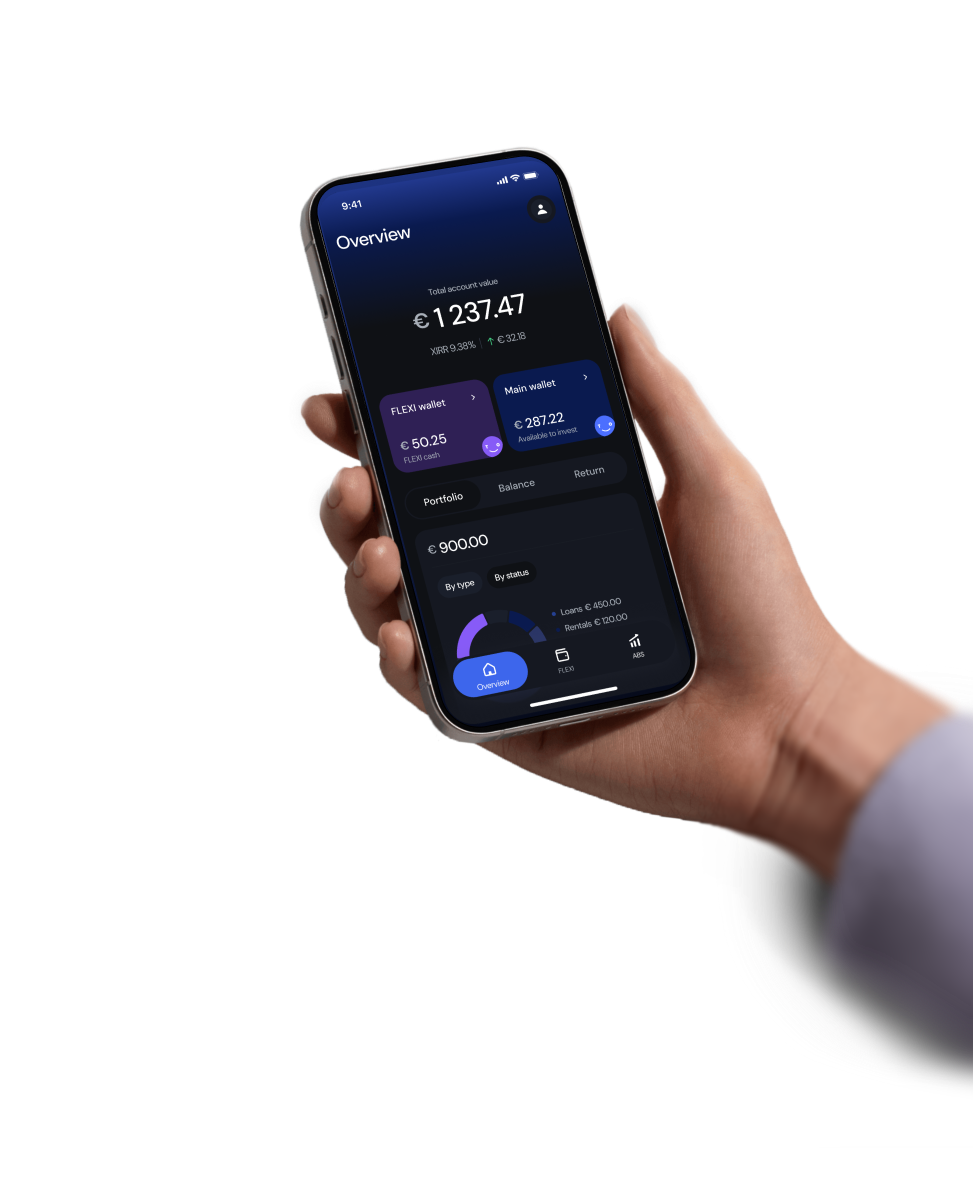
The website can be switched entirely to German, by the way, and for a few weeks there's also been an app – not with the full feature set, but for Flexi and wallet management it's completely sufficient.
TWINO Flexi: 6% interest with daily availability
Now to the actual star and the reason I completely switched my strategy on TWINO: TWINO Flexi*, launched in spring 2026. I got in in mid-May, when the product was just two weeks old.
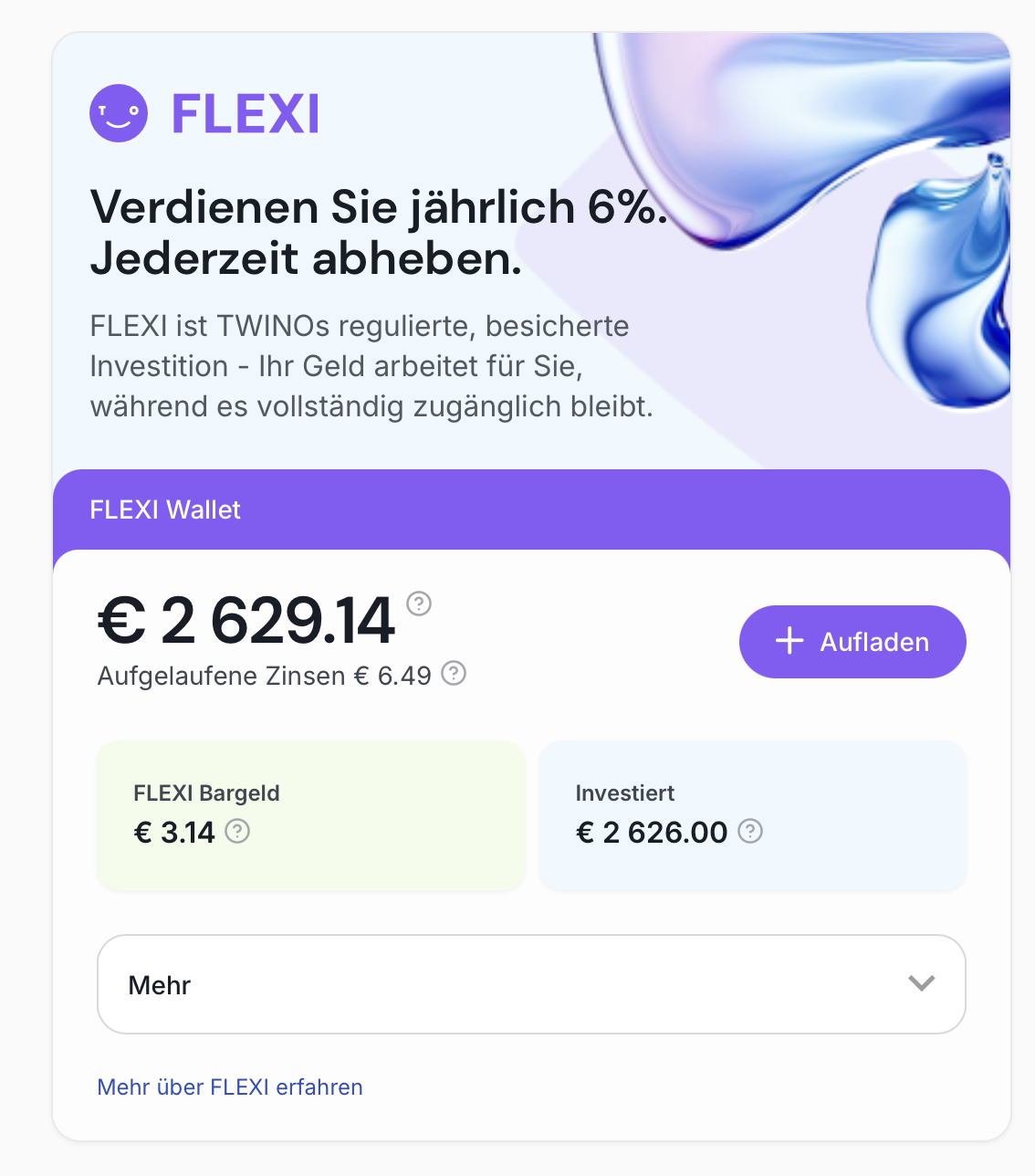
Here's how it works:
- You top up your separate Flexi wallet (from the main account or directly by bank transfer); from €10 it's automatically invested.
- You get a fixed return of 6% per year. Interest is calculated daily but – unlike with Go & Grow – credited once a month. If you exit in between, you receive the accrued interest paid out to the day.
- Under normal circumstances your money is available at any time – payout to the main account or directly to your bank account. The only restriction I found: freshly invested money can only be withdrawn again from midnight.
- In the background your money is in the same 12-month securities that yield 12% on the primary market – structured so that withdrawals are possible without the detour via the secondary market. So half the return is the price for the liquidity.
- There is currently a limit of €10,000 per investor, and the total capacity is also capped (when I last looked, just under €95,000 was still free). So the product grows in a controlled way – which I find sensible, because the liquidity mechanism has to match the credit base.
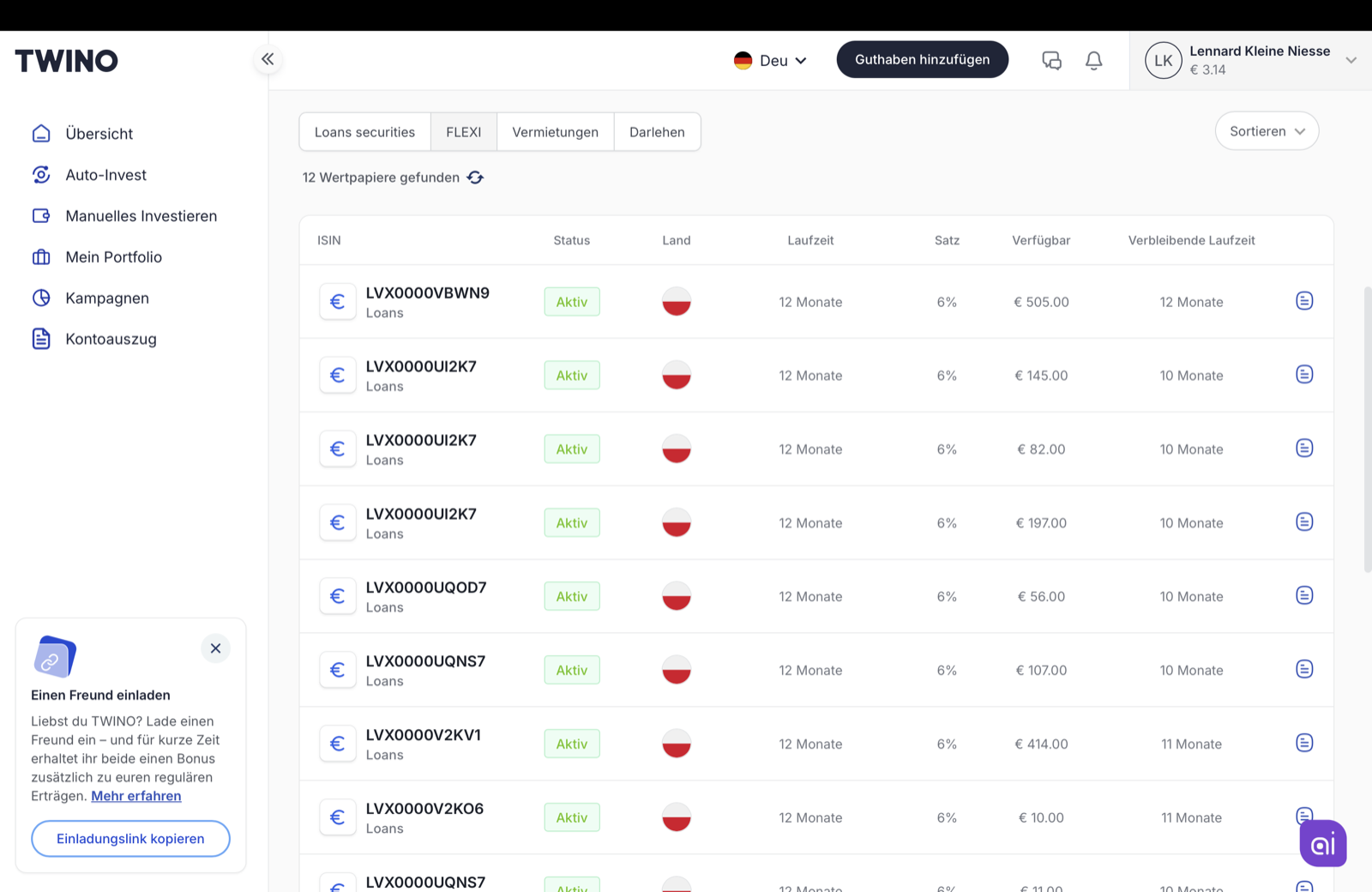
Here's what it looks like in the portfolio: my Flexi balance is in completely normal 12-month securities (Polish loans), just at a 6% rate and with the built-in exit option:
The special thing: as far as I know, Flexi is the first product of its kind – daily liquid, fixed return – that runs entirely within a MiFID II-regulated framework with an approved base prospectus. Bondora Go & Grow* has been around for years, but precisely without this regulation.
My TWINO experience: 3 months, 4 updates
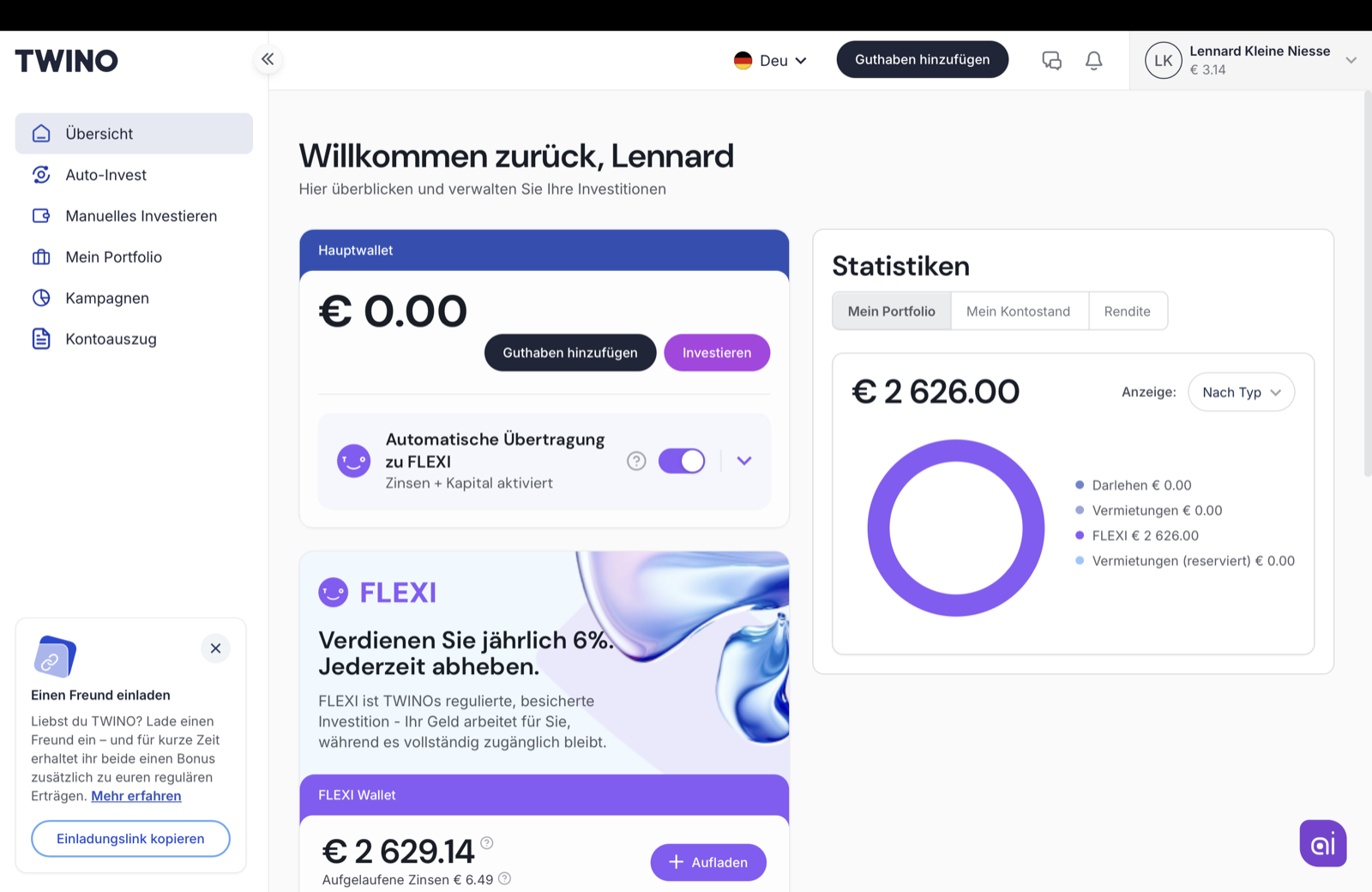
I've documented my TWINO* investment transparently on YouTube from the start – here's the short version of my journey so far. This is what my dashboard currently looks like (the main wallet is empty because everything moves directly to Flexi – including the automatic transfer of interest and capital, which you can conveniently enable):
May 2026 – the entry (around €1,100): on 12 May I deposited €1,000 and bought two loan packages of €500 each on the primary market (Polish loans, 12 months, 12%). Two days later I added €100, with which I tried out the then brand-new Flexi. Onboarding, verification, deposit – everything ran smoothly, the dashboard is tidy and self-explanatory.
June 2026 – Flexi becomes the focus (around €1,600): added €500, entirely into Flexi – just like all the interest from the loans. The first interest credit came as announced, and the liquidity forecast had predicted almost to the cent beforehand what would come (around €10 per month on my €1,000 in the 12% packages).
July 2026 – the practical test (around €2,100): deposited €500 again. Deposits arrive surprisingly quickly – transferred in the afternoon, on the platform a few hours later. I also tested the withdrawal process: €10 out of Flexi to the main account, instant, back in – no waiting times, no fees. That's exactly how I imagine a liquidity building block.
August 2026 – all into Flexi (around €2,626): I sold my two manual loan packages via the secondary market – quick and hassle-free – and put the proceeds together with another €500 into the Flexi wallet. I've earned just under €12 in interest so far. Sounds unspectacular, but at 6% p.a. and a growing balance it's exactly what was to be expected.
You can see the jump from the last €500 deposit nicely in the portfolio performance chart – this is how the whole thing keeps growing month by month in steps:
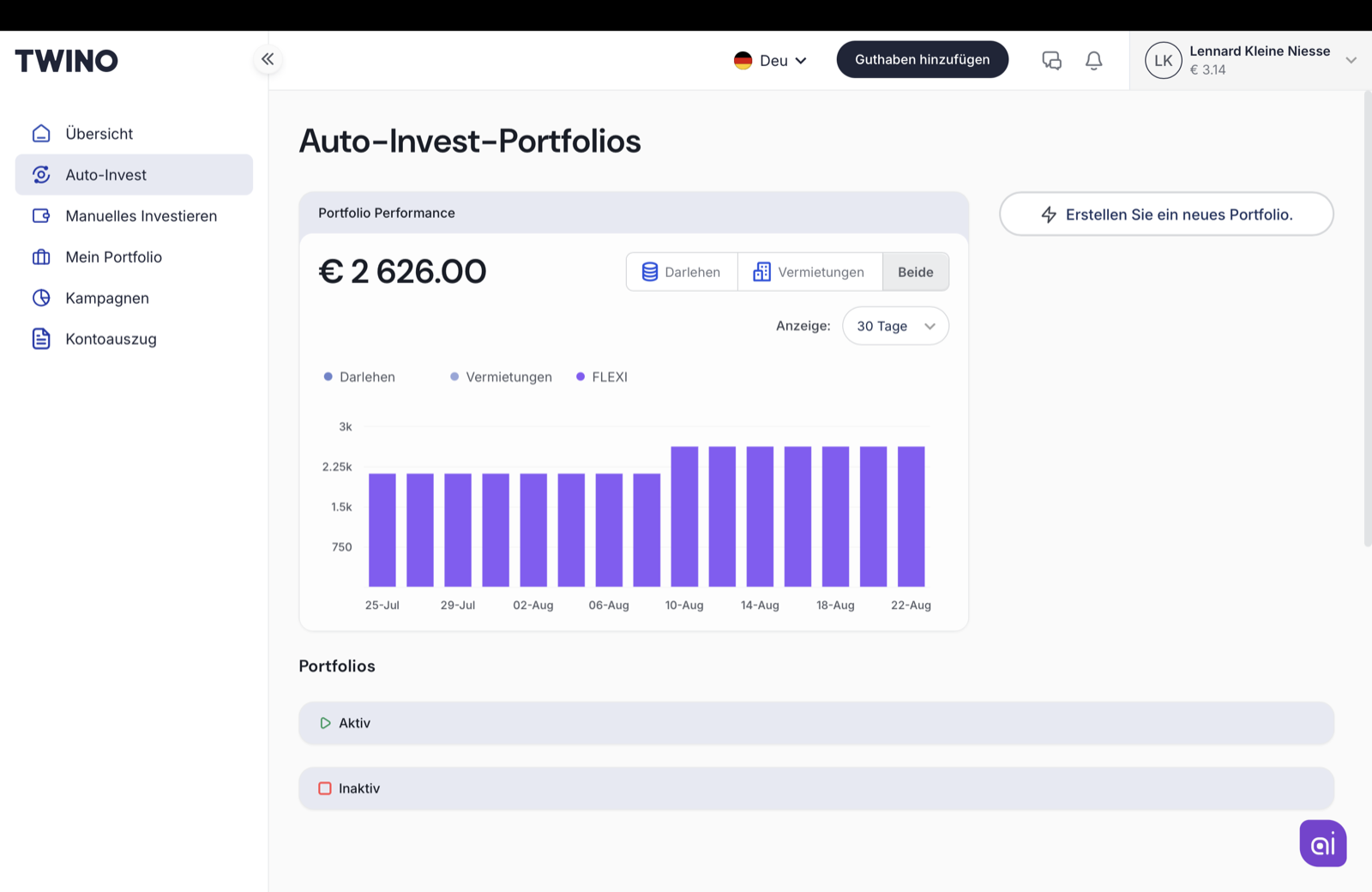
My plan: keep depositing €500 per month until the €10,000 Flexi limit is full. That also fits my personal rule, which I follow consistently in my P2P portfolio: with regulated platforms I allow myself up to €10,000 per platform, with unregulated ones I stop at €5,000.
Flexi vs. Go & Grow vs. a savings account
A friend recently said to me: "Flexi is actually the better savings account." And that's exactly where I have to disagree – this framing is dangerous. The honest comparison:
- Savings account: currently around 2–3% interest, available daily, state deposit protection up to €100,000. That's the safe base – no P2P product competes with that.
- Bondora Go & Grow: up to 6% interest (cut from 6.75% to 6.00% in April 2025), available daily, daily interest credit – but unregulated and without investor compensation.
- TWINO Flexi: 6% interest, available daily, monthly interest credit with daily calculation – MiFID II-regulated, with a base prospectus and investor compensation (90% up to €20,000, only in the event of platform insolvency/fraud).
My conclusion from the comparison: Flexi is not a savings-account replacement – it's a completely different asset class with credit risk and no deposit protection. But within the P2P world it's currently the most interesting liquidity building block for me: the same return as Go & Grow, but in a regulated framework. That's exactly why I'm building up Flexi alongside Go & Grow and Monefit* as a further liquidity block in my P2P portfolio.
Fees
The good news: registration, investing, deposits and withdrawals – all free. There's exactly one fee to watch out for: the inactivity fee of €10 per month. But it only applies if you haven't invested for longer than 6 months and either have no active investments left at all or have more than 15% of your total balance sitting uninvested. In short: anyone who is invested or simply withdraws their money never pays anything. Fair and transparently disclosed – but you should know about it.
Taxes: 5% withholding tax, the rest via the tax return
Two things you need to know as a German investor:
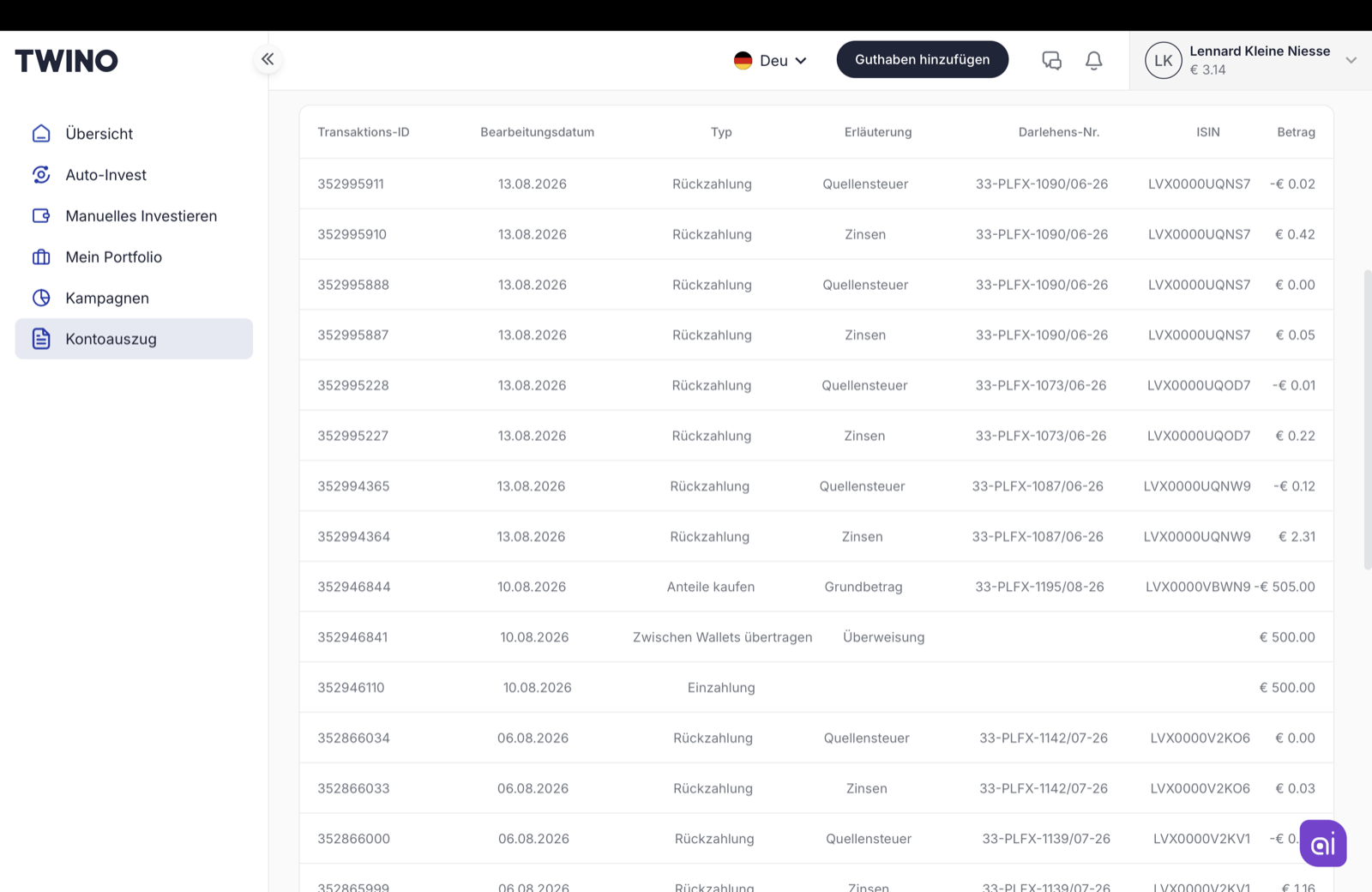
Latvian withholding tax: since January 2023, Latvian platforms have withheld a flat rate of only 5% withholding tax on interest for private investors from the EU/EEA (previously 20%). A certificate of residence is no longer required for this – simply setting your tax country in your profile is enough. The 5% is fully creditable against the German flat-rate tax, so no double burden arises on balance. You see the deduction transparently in your account statement – for me it appears there cleanly as a separate item with every interest payment:
German tax: TWINO* – like all foreign platforms – does not automatically deduct German flat-rate tax. You have to declare the interest income yourself in your tax return (KAP annex). Handy: the dashboard has ready-made annual income statements for download, which makes the tax return pretty painless.
(As always: this is not tax advice – when in doubt, please clarify with your tax advisor.)
Risks and criticism: the honest side
No review without the downsides – and with TWINO*, a look at its recent history is part of the truth. The platform used to be active in significantly more countries, and this expansion course cost investors real money and nerves:
Russia: after the attack on Ukraine in 2022, investor funds from the Russian lender Moneza were stuck due to capital controls – around €6.8 million was blocked at times, and repayments only came in small tranches for years. In early 2026 about €1.9 million was still open, plus there was a (heavily oversubscribed) buyback offer at 80% of capital plus 100% of interest. The important end of the story: on 5 August 2026 TWINO returned the final tranche – the Russia chapter is fully closed after more than four years, and all investors received their capital and interest. I give them a lot of credit for fighting through it rather than simply writing it off. But it also shows how long something like that can take.
Philippines: fully repaid in January 2026 – TWINO bore part of the losses (around €70,000) out of its own pocket.
Vietnam: the sore point. The exit came late (March 2024, competitors were out much earlier), risk management was weak in hindsight, and investors face losses of around €1.6 million – with limited prospects of recovery. That has to be stated clearly.
What does this mean for today? TWINO has consolidated radically and focuses almost entirely on Poland. That makes the platform much more predictable – but also creates a cluster risk: one country, one lender. On top of that, from November 2026, the new EU Consumer Credit Directive (CCD2) comes into effect, which is likely to bring stricter creditworthiness checks and interest rate caps in Poland – it's quite possible that returns will fall as a result in the medium term.
And of course the classic P2P risks apply: loan defaults, platform risk, liquidity risk (even with Flexi – in a "bank run" scenario delays are possible), no guaranteed interest. Only invest money here whose total loss you could absorb.
Who is TWINO worth it for?
- are looking for a regulated P2P platform with a MiFID II licence, base prospectus and investor compensation
- want to add a liquid building block with 6% interest and daily availability to your P2P portfolio via Flexi
- alternatively want to earn up to 12% interest with fixed terms
- value a working secondary market and fast deposits/withdrawals
- know the risks of credit investments and only invest free capital
- are looking for a safe savings-account replacement with state deposit protection
- don't want to accept concentration on one country (Poland) and one lender
- expect guaranteed returns – even Flexi has no guarantee
- don't want your money tied up temporarily under any circumstances (i.e. liquidity risk)
My verdict on TWINO
TWINO is currently one of the most interesting P2P platforms for me – not despite, but because of its history. The legacy issues from Russia and the Philippines were cleaned up in 2026 rather than hidden, the focus on the profitable Poland business is understandable, and the MiFID II regulation with a base prospectus and investor compensation sets the platform apart from most of the P2P market.
With Flexi, TWINO has built what is currently the most interesting liquidity product in the P2P space for me: 6% with daily availability, in a regulated framework – "the regulated Go & Grow alternative" describes it pretty accurately. That's why my monthly €500 currently flows entirely there, until the €10,000 limit is reached.
But – and this matters to me: it remains a credit investment. Anyone looking for a savings-account replacement is in the wrong place. Anyone deliberately looking for a high-yield, liquid building block for their P2P portfolio who understands the risks should definitely take a look at TWINO* – through my link you currently get up to 2% cashback on your investments (remember to activate the campaign once in the "Campaigns" tab after registering).
Frequently asked questions
What is TWINO Flexi?
TWINO Flexi is an investment product with a fixed return of 6% per year and daily availability. Your money is automatically invested in 12-month asset-backed securities that are structured so you can pay in and withdraw at any time – from €10, currently with a limit of €10,000 per investor.
Is TWINO safe and regulated?
TWINO has been licensed as an investment brokerage firm by the Latvian central bank (MiFID II) since August 2021, and since June 2026 it also holds a MiCA authorisation. A base prospectus requirement, segregated client funds and a statutory investor compensation of 90% up to a maximum of €20,000 apply – but that only kicks in if the platform becomes insolvent or commits fraud, not for loan defaults. It remains a credit investment with a risk of loss.
Is TWINO Flexi a savings-account replacement?
No. Even though Flexi is available daily like an instant-access savings account, you're investing in consumer loans – without state deposit protection and with real credit risk. The 6% return is the compensation for this risk. A savings account and Flexi are completely different asset classes.
How quickly do I get my money out of TWINO Flexi?
In my test, a withdrawal from Flexi to the main account was instant; to a bank account it usually takes one banking day. The only restriction: freshly invested money can only be withdrawn again from midnight. If many investors rush at the same time, delays are possible according to the terms.
What taxes apply with TWINO?
Latvia automatically withholds 5% withholding tax on interest for EU private investors, which is fully credited against the German flat-rate tax. You declare the German tax yourself via the KAP annex – ready-made income statements are available for download in the TWINO dashboard.
What fees does TWINO have?
Registration, investing and deposits/withdrawals are free. There is only an inactivity fee of €10 per month – but that only applies if you haven't invested for over 6 months and at the same time have idle funds lying around. Anyone who is invested or withdraws their money never pays anything.
What happened to the Russian loans at TWINO?
After Russia's war of aggression in 2022, around €6.8 million of investor money was temporarily blocked by capital controls. TWINO managed the recovery in tranches over years and made the final payment on 5 August 2026 – all investors received their capital plus interest back in full.
Disclaimer
⚠️ Not investment advice
All content is for information and entertainment purposes only and does not constitute investment advice, a buy recommendation or an invitation to enter into a financial product. Please do your own research and make decisions based on your personal situation and risk tolerance.
📉 Risk warning & total loss
Investments in securities and other financial instruments generally carry significant risks (e.g. price, market, currency, volatility and credit risks). A total loss of the capital invested cannot be ruled out.
📊 Returns & forecasts
All performance figures, whether historical or as a forecast/estimate, are not a reliable indicator of future results. Capital and returns are not guaranteed.
🔍 Transparency & conflicts of interest
I strictly distinguish between facts and personal estimates. Important: I am often invested in the assets discussed myself, which can create a conflict of interest.
✅ DYOR (Do Your Own Research)
All information has been compiled carefully but is non-binding, without warranty and without any claim to completeness. Please inform yourself thoroughly and consider all opportunities and risks in depth before making an investment decision.
Advertising & affiliate notice
Links marked with * are advertising or affiliate links. If you sign up or buy something through such a link, I may receive a commission – at no extra cost to you. This supports my work.