Afranga Review 2026: My Honest Test After 11 Months (up to 16% interest, ECSP-regulated)
My in-depth Afranga review: I've been investing on the ECSP-regulated P2P platform from Bulgaria since October 2025 – now €1,301.50 with €81 in interest and €0 overdue. How SaveSmart and the Marketplace work, why there's finally a secondary market, how safe Afranga really is, what the Stik-Credit entanglement means, what taxes apply, how to get the 0.5% bonus – and who Afranga is right for.
Table of contents
- Afranga at a glance
- What is Afranga?
- Is Afranga legit and regulated?
- The two products: SaveSmart and Marketplace
- Update: Afranga now has a secondary market
- Signing up: getting started in three steps
- Fees
- My Afranga experience: 11 months, €0 overdue
- What return is realistic on Afranga?
- Taxes on Afranga: 10% withholding, 5% of it lost
- Risks and criticism: the honest side
- The most common beginner mistakes on Afranga
- Afranga vs. other P2P platforms
- The Afranga bonus: 0.5% cashback
- Is Afranga worth it?
- My verdict on Afranga
- FAQ
I've been investing on Afranga*, an ECSP-regulated P2P platform from Bulgaria, since October 2025 – starting with a small test position, now up to €1,301.50, and I've just topped up again. In this in-depth review I'll take you through my first eleven months: how investing works via SaveSmart and the Marketplace, why there's finally a secondary market, how safe Afranga really is, what taxes apply, how to get the bonus – and where the honest weak spots are.
As always, the most important note upfront: this is not investment advice and not a buy recommendation. I only show my personal investments and my personal opinion. I'm responsible for my money, you for yours – especially in P2P and credit investing the risks are substantial, up to total loss. Do your own thorough research and always make your own decision.
Afranga at a glance
If you're short on time, here's the short version of my Afranga test:
- What: P2P marketplace from Sofia, Bulgaria, for business and consumer loans, live since 2021.
- Regulation: ECSP licence from Bulgaria's FSC (Resolution 863/12.09.2023), client funds held separately at Lemonway.
- Two products: SaveSmart (hands-off, fixed 8–10%, monthly interest) and Marketplace (active, up to 16%, 3–36 months).
- Entry: from €10, no investor fees.
- New: a working secondary market (over 2,700 listings) – early exit is now possible.
- No buyback, no deposit insurance, no compensation scheme – you carry the credit risk.
- My status: €1,301.50, €81.02 interest, €0 overdue after 11 months.
- Bonus: 0.5% cashback on all investments in the first 90 days via my partner link*.
What is Afranga?
Afranga* is a P2P marketplace from Sofia, Bulgaria, where you invest in loans from Bulgarian and Czech lenders. The platform launched in 2021 and today advertises over €100 million in invested volume and more than 5,000 investors. Its roots lie with the Bulgarian lender Stik-Credit; since 12 September 2023 Afranga has operated as an independent, ECSP-licensed company. It's run by Svetlin Sabev, who simultaneously holds positions at Stik-Credit and the lender Lendivo – a point I'll come back to under risks.
Honestly, Afranga is a small, young platform – not a billion-euro platform like Mintos. That's both a blessing and a curse: lean, fast and easy to navigate, but with a limited loan supply and a still short track record. That's exactly why, with a platform like this, I look especially closely at regulation, ownership structure and the lenders' financials.
Is Afranga legit and regulated?
The main reason Afranga made it into my portfolio at all is the regulation. Since 12 September 2023, Afranga has held an ECSP licence (European Crowdfunding Service Provider) from Bulgaria's financial regulator FSC (Resolution No. 863), based on EU Regulation 2020/1503. In practice that means:
- Client funds are held separately from company assets in individual e-wallets with the French payment institution Lemonway (an e-money institution regulated by France's ACPR). Your money never runs through Afranga's own accounts.
- Every loan comes with a standardised Key Investment Information Sheet (KIIS) covering the main figures and risks.
- Before your first investment you must complete a suitability test, and as a non-professional investor you have a 4-day withdrawal right.
- Afranga reports regularly to the FSC and is subject to its ongoing supervision.
Crucially, and I stress this every time: this regulation does not protect against loan defaults. The FSC supervises the platform and its processes – but not whether an individual loan is good or bad. Afranga states plainly itself: "Capital at risk. Not covered by any deposit guarantee scheme or investor compensation scheme." So there is no deposit insurance (Afranga is not a bank) and no investor compensation scheme. You carry 100% of the credit risk.
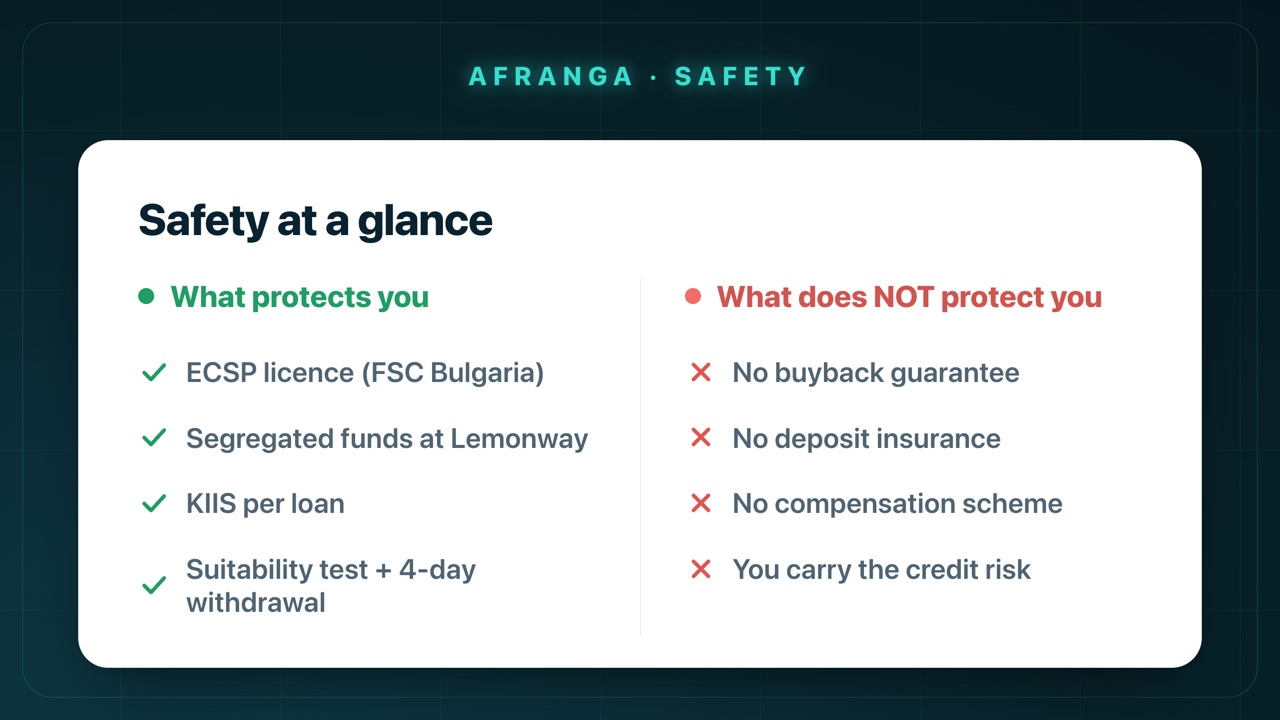
For me the ECSP licence is still a genuine quality marker: it lifts Afranga above the large unregulated part of the P2P market and ensures segregated funds, standardised info sheets and a regulator in the background. But it's not a safety net against bad loans – that distinction is essential.
The two products: SaveSmart and Marketplace
Afranga has two products you should keep clearly apart – they appeal to completely different investor types.
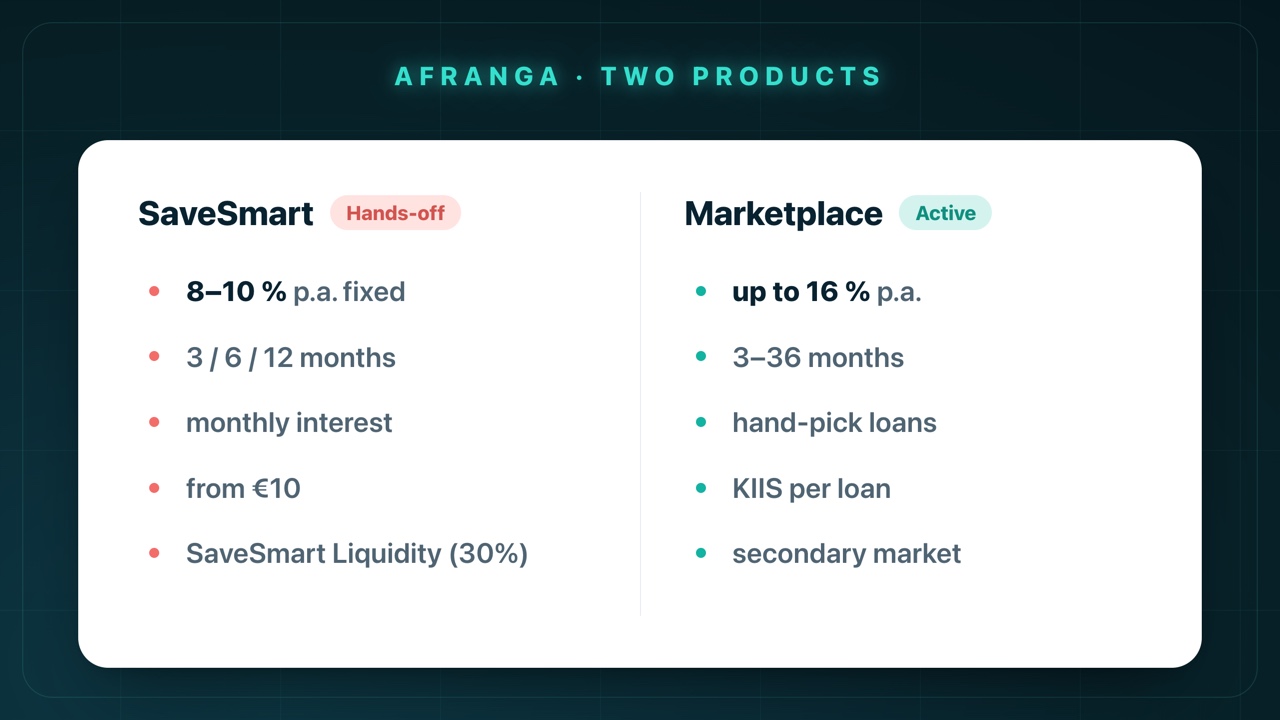
| SaveSmart (hands-off) | Marketplace (active) | |
|---|---|---|
| Principle | Pick term + rate, Afranga allocates automatically | Hand-pick individual loans |
| Interest | fixed 8–10% p.a. | up to 16% p.a. (usually 9–14%) |
| Term | 3 / 6 / 12 months | 3–36 months |
| Interest payout | monthly | per repayment schedule |
| Minimum | €10 | €10 |
| Early exit | SaveSmart Liquidity (30%, 1% fee) | Secondary market (if a buyer exists) |
| For whom | Simplicity, "set and forget" | Control, yield optimisers |
SaveSmart in detail
SaveSmart is the passive product: you only pick a term and rate, and Afranga handles the rest, automatically spreading your money across vetted loans. It pays a fixed 8% (3 months), 9% (6 months) or 10% (12 months), with monthly interest and optional auto-reinvestment – from €10. It's backed by lender Stik-Credit.
Since August 2026 there's SaveSmart Liquidity: you can withdraw up to 30% of your SaveSmart balance (max €5,000 per transaction) early – for a 1% fee. That takes some of the "money is locked" worry out of the product. But be careful: SaveSmart is also a credit investment, not a savings account and with no deposit insurance. If you're looking for a safe place to park an emergency fund, this isn't it.
Marketplace in detail
On the Marketplace you pick individual loans yourself – from €10 per loan. Interest typically ranges from 9% to 14% (the homepage advertises up to 16%), with fixed terms of 3 to 36 months. Before each investment you see the KIIS and the full repayment schedule – full transparency on rate, term and lender. Important: you enter direct contracts with the borrowing companies – there is no buyback guarantee if a loan defaults.
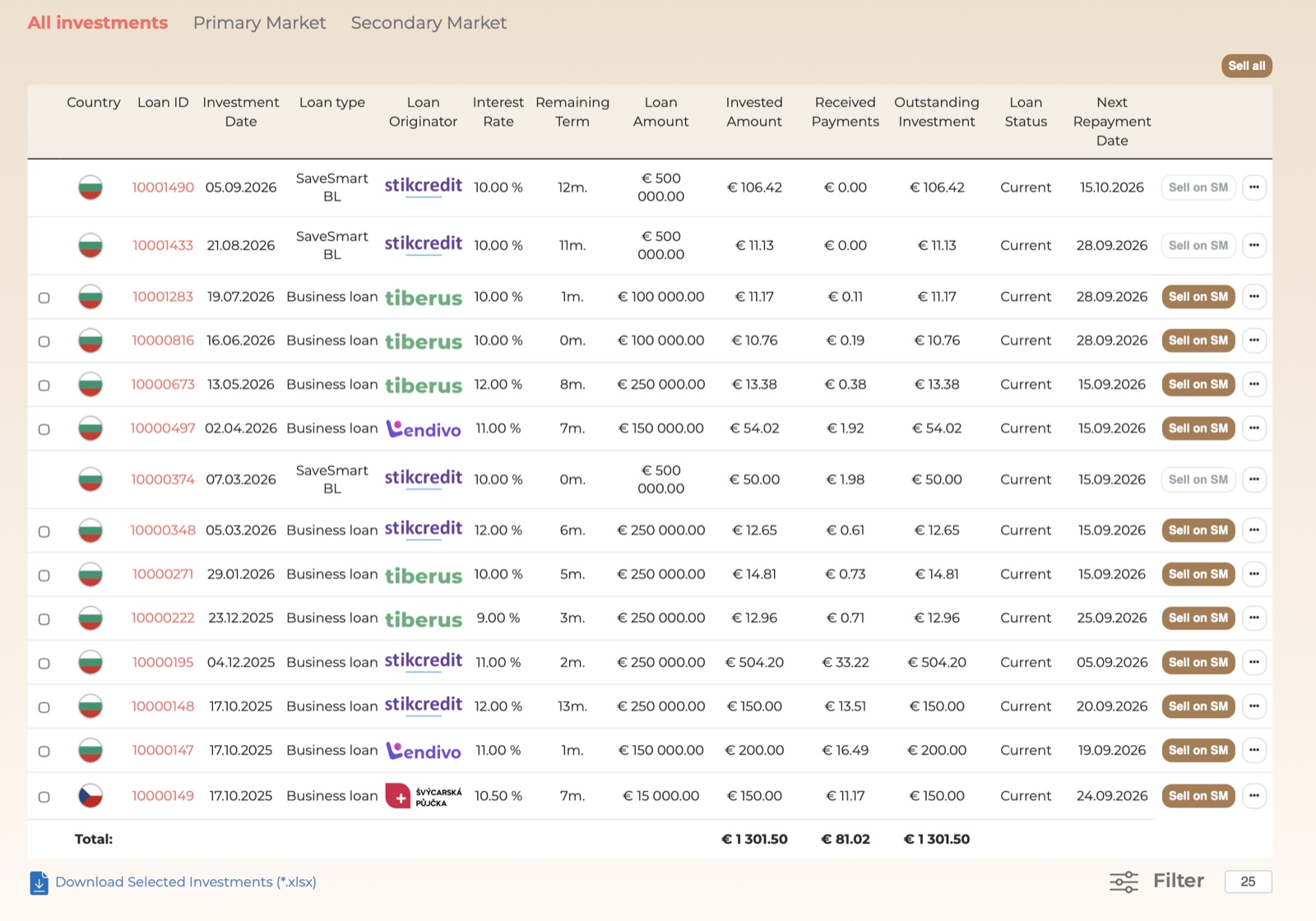
Here's what my "All Investments" overview looks like – you can clearly see the different lenders, terms and interest rates, plus the "Current" status (on schedule) across all positions:
Update: Afranga now has a secondary market
For a long time the biggest criticism of Afranga was that Marketplace loans were locked until maturity – no early exit possible. That has changed: Afranga has now launched a secondary market where you can sell your Marketplace loans early to other investors (the "Sell on SM" or "Sell all" button). And the market is surprisingly active – last time I looked, there were over 2,700 listings.
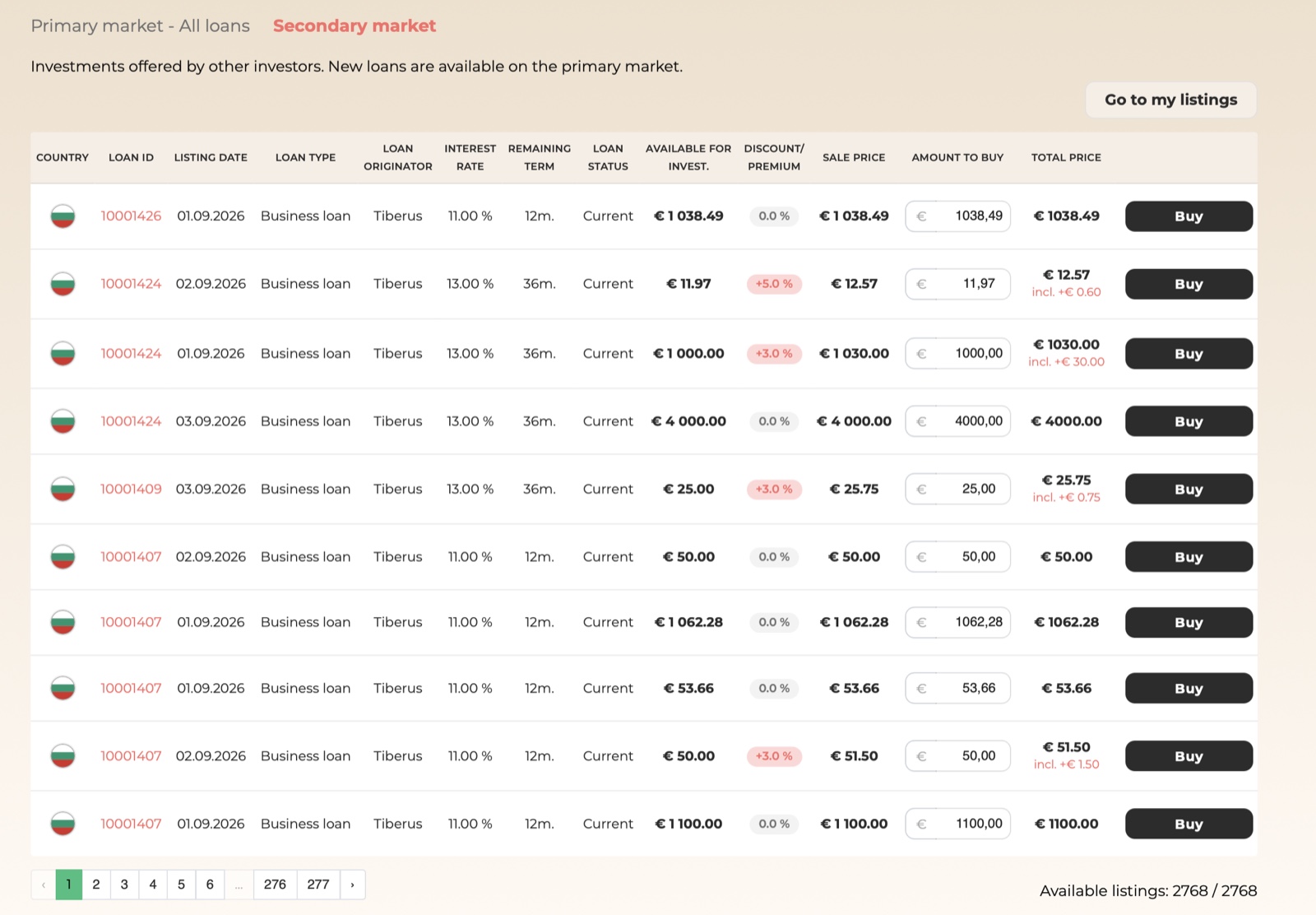
Loans are sold (and bought) with discounts or premiums: I see offers ranging from 0% to +5% premium – so sought-after loans with a good rate-to-term ratio trade at a premium, exactly what you'd expect from a functioning secondary market. For me this is real progress, because it significantly eases the old "money is locked until the end" problem. Two caveats remain: SaveSmart positions can't be sold on the secondary market (that's what SaveSmart Liquidity is for), and it's not a guaranteed sale either – you need a buyer.
Signing up: getting started in three steps
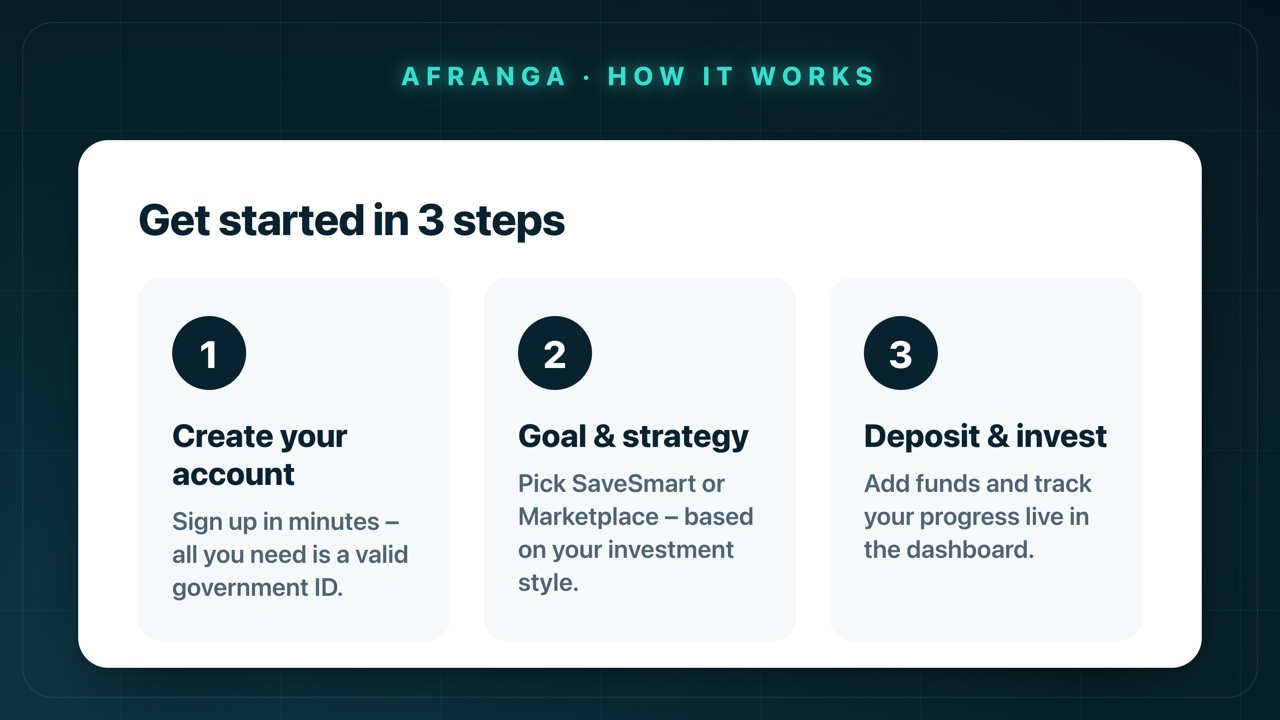
Registration is straightforward and takes only a few minutes. Afranga itself sums it up in three steps:
- Create your account – sign up with the streamlined verification process; all you need is a valid government-issued ID.
- Set your goals – define what you're saving for and by when; the system suggests a suitable strategy (SaveSmart or Marketplace).
- Start earning – deposit funds, invest and track your progress live in the dashboard.
Two practical points from my own experience that save you hassle: set up bank verification with Lemonway right at the start – then there's no delay on your first withdrawal. And note: deposits are only accepted from your own bank account, not from third-party accounts.
Fees
The good news: for investors, Afranga is completely free – account opening, investing, deposits and withdrawals cost nothing. There's exactly one fee to watch out for: the 1% fee for early SaveSmart Liquidity withdrawals. If you stay invested to maturity as normal, you never pay a thing. It's one of the fairest fee models in P2P.
My Afranga experience: 11 months, €0 overdue
I document my Afranga* investment transparently – here's the current status from my dashboard. My account balance is €1,301.50, of which €1,195.08 is invested and €106.42 freshly deposited (currently moving into SaveSmart). I've earned €81.02 in interest so far – and, most importantly to me: €0.00 overdue, every loan is running on schedule.
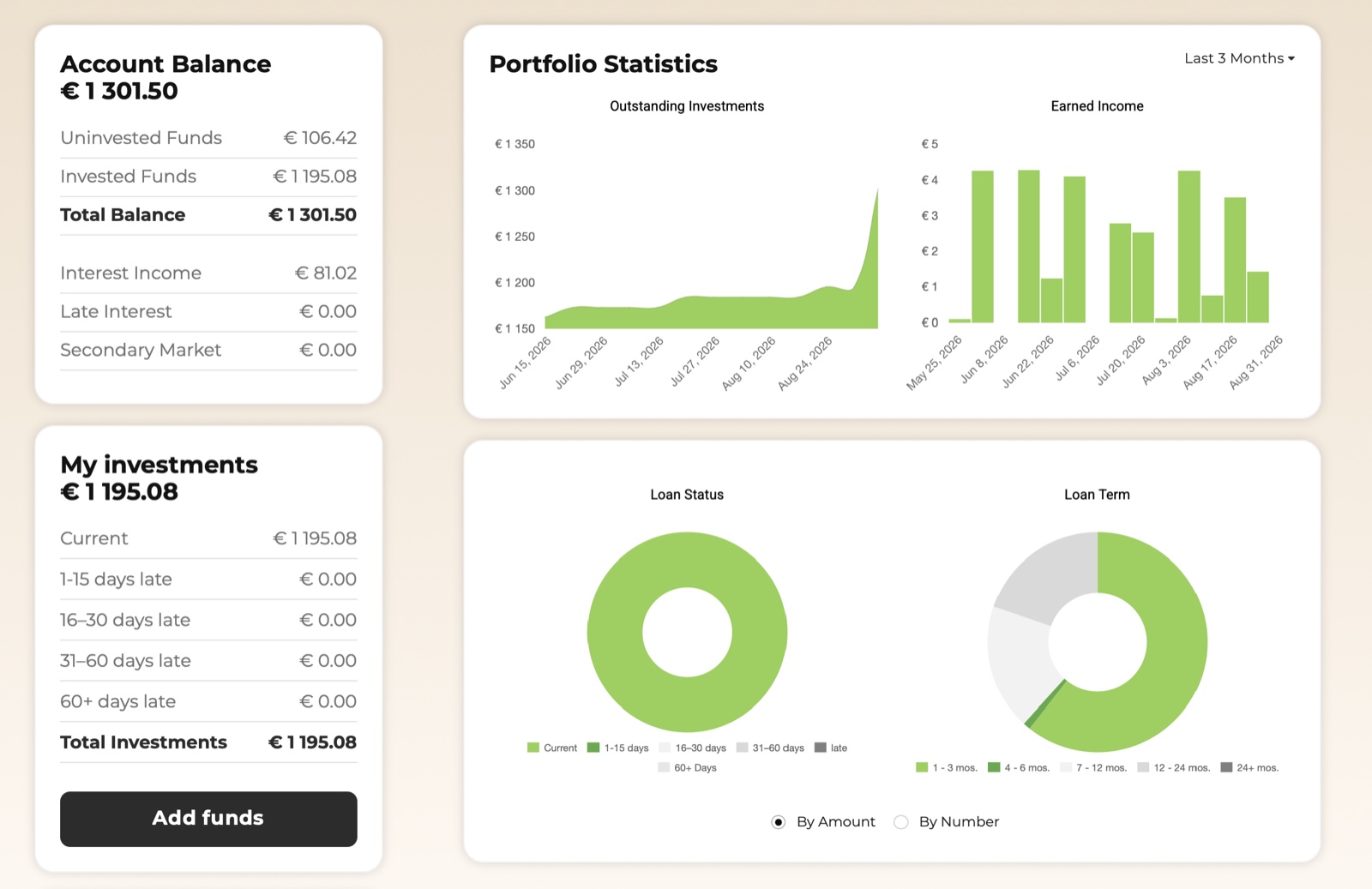
The capital is spread across roughly 14 positions over several lenders – Stik-Credit, Tiberus (vehicle-secured loans) and Lendivo from Bulgaria, plus one Czech loan via Swiss Funds. The interest rates on my loans range from 9% to 12%, plus my SaveSmart position at 10%. The most recent increase is because I just topped up again – clearly visible in the small jump in the portfolio curve.
My verdict after eleven months: quietly and reliably doing its job. Deposits and monthly interest credits arrived on time, the dashboard is tidy, and so far I haven't had a single default or late loan. That's never a guarantee for the future in P2P – but a solid start. Afranga stays a deliberately smaller position for me: as with my P2P portfolio in general, my rule is to keep unregulated and young, small platforms carefully capped and to diversify broadly across many providers.
What return is realistic on Afranga?
On paper, 8–16% sounds dreamy. Realistically, you should factor in two deductions:
- Withholding tax: roughly 5% of your gross interest is effectively lost (see the tax section).
- Defaults: without a buyback, a defaulted loan can drag down your return. For me, €0 has defaulted so far – but that's no guarantee.
Bottom line, a net return in the high single digits is realistic when things go well – a bit more predictable with SaveSmart, and with more upside and more risk on the Marketplace. That's exactly why broad diversification across many loans (and across several platforms) matters so much.
Taxes on Afranga: 10% withholding, 5% of it lost
Two things you need to know as an investor:
Bulgarian withholding tax: Bulgaria automatically withholds 10% tax on your interest (Czech loans: 15%). The catch: under the German-Bulgarian double taxation treaty, only 5 percentage points are creditable in Germany – so roughly 5% of your gross interest is effectively lost. Factor this into your return expectations and check the repayment schedule before investing to see what's left net.
German tax: Afranga – like all foreign platforms – does not automatically deduct German withholding tax. You report the interest income yourself in your tax return (Anlage KAP). Handily, there's an annual tax certificate to download in your account, which makes the tax return much easier.
(As always: this is not tax advice – please clarify with your tax advisor if in doubt.)
Risks and criticism: the honest side
No review without the downsides – and Afranga has a few points you need to know:
Concentration risk and interlinked ownership. This is the most important point for me. Almost all loans run through Bulgaria, and the dominant lenders belong to a closely connected group: CEO Svetlin Sabev is simultaneously active at Afranga, Stik-Credit and Lendivo. Anyone who thinks they're diversifying broadly across different lenders is in reality partly diversifying into the same group. That's not what diversification looks like.
Declining profitability at Stik-Credit. The key lender behind Afranga (and behind SaveSmart) took a noticeable hit in 2025: net profit fell 35.4% to around €2.25 million, loan-loss provisions rose 40.6%, and the equity ratio dropped from 54% to 44%. Stik-Credit is still profitable – but the direction bears watching, because a lot rides on this lender.
No buyback guarantee. Unlike Mintos or Lendermarket, you carry the default risk directly. The new secondary market helps with early exits, but it's no substitute for a buyback.
Small platform, mixed reputation. Afranga is young and small, the loan supply on any given day is limited, and on Trustpilot the platform sits at around 2.9 out of 5 stars (with still few reviews) – rather mixed; recurring complaints are slow payouts and account verification with Lemonway.
And of course the classic P2P risks apply: loan defaults, platform risk, liquidity risk, no guaranteed return. Afranga itself recommends in its terms putting no more than 10% of your net worth into crowdfunding. Only invest money you could afford to lose entirely.
The most common beginner mistakes on Afranga
From my own experience and the community's questions – here's how to avoid the typical mistakes:
- Mistaking Afranga for a savings account. SaveSmart is also a credit investment with no deposit insurance. The secondary market and SaveSmart Liquidity help, but they're not a guaranteed instant exit.
- Ignoring the withholding tax. Factor the effectively lost ~5% into your return expectations from the start.
- Underestimating concentration risk. Stik-Credit, Lendivo and Afranga are connected – "diversifying" across those names is only half the diversification.
- Wasting the cashback. The 90-day window starts at registration – so only sign up once your starting capital is ready.
- Setting up withdrawals too late. Verify your bank account with Lemonway early, otherwise your first withdrawal will stall.
Afranga vs. other P2P platforms
Where does Afranga sit in the P2P field? A quick attempt to place it:
- vs. Mintos: Mintos is much larger, more broadly diversified (many countries, multi-asset) and offers a buyback on many loans. Afranga is smaller and more focused, with a very lean interface – but without a buyback guarantee.
- vs. TWINO: Both are regulated. TWINO's Flexi is a liquid 6% product, while Afranga offers higher headline rates via SaveSmart and the Marketplace – but with the Bulgaria concentration risk.
- vs. Bondora Go & Grow: Go & Grow is better known and very liquid, but unregulated. Afranga is ECSP-regulated, but not quite as "one-tap" liquid.
For me these platforms complement each other in a portfolio rather than being mutually exclusive – broad diversification is what matters. I show my complete setup transparently in my P2P portfolio update.
The Afranga bonus: 0.5% cashback
Via my partner link you currently get 0.5% cashback on all investments within the first 90 days after registration – calculated on your total invested volume, not just the first deposit. You don't need a code; it's tracked automatically through the link. A few examples:
- €1,000 invested → €5 cashback
- €5,000 invested → €25 cashback
- €10,000 invested → €50 cashback
On top of that, Afranga has its own refer-a-friend programme: €50 for you and €50 for your friend if both invest at least €2,000 (your friend signs up via your link and invests within 30 days).
A practical tip from my own experience: only register once your starting capital is actually ready – the 90-day cashback window starts at sign-up, not at your first deposit.
Who is Afranga right for?
- want an ECSP-regulated platform with segregated client funds (Lemonway)
- want fixed interest of 8–10% (SaveSmart) or up to ~16% (Marketplace) with monthly payments
- want to invest with no investor fees – from as little as €10
- want to use the new secondary market for early exits
- understand the risks of credit investments and only invest spare capital
- expect a buyback guarantee – there isn't one here
- want a safe savings-account substitute with state deposit insurance
- won't accept concentration risk (one country, the interlinked Stik-Credit group)
- need a large, broadly diversified platform with a big loan supply
- want guaranteed, instant access to all of your capital at any time
My verdict on Afranga
Afranga is, for me, a solid, honestly regulated small P2P platform – with clear strengths and clear limits. On the plus side: the ECSP licence with segregated client funds via Lemonway, fixed interest of 8–16%, monthly payments, no investor fees and – brand new and a genuine plus for me – a functioning secondary market that eases the old liquidity problem. Across my eleven months everything ran smoothly and without a single late payment.
On the minus side there remain the concentration risk around the interlinked Stik-Credit group, that lender's recently weaker profitability, the lack of a buyback guarantee, and the platform's overall still small size. For me that means: Afranga yes – but deliberately as a smaller, well-monitored position within a broadly diversified P2P portfolio, not as a large single building block.
If you're looking for a regulated P2P platform with attractive interest and you understand the risks, take a look at Afranga* – via my link you get 0.5% cashback on all investments within the first 90 days.
Frequently asked questions
Is Afranga legit and regulated?
Afranga is licensed as a European Crowdfunding Service Provider (ECSP) by Bulgaria's financial regulator FSC – Resolution 863 of 12 September 2023, under EU Regulation 2020/1503. Client funds are held separately in individual e-wallets with the French payment institution Lemonway. Every loan comes with a standardised information sheet (KIIS), there's a suitability test before your first investment and a 4-day withdrawal right. Important: the regulator does not vet each individual loan, and per Afranga there's no deposit insurance and no investor compensation scheme – the credit risk stays with you.
How high is the interest on Afranga?
On the Marketplace, interest typically ranges from 9% to 14% per year (the homepage advertises up to 16%), with terms of 3 to 36 months. SaveSmart pays a fixed 8% (3 months), 9% (6 months) or 10% (12 months) with monthly interest payments. In my own portfolio the rates sit between 9% and 12%.
What is SaveSmart on Afranga?
SaveSmart is the hands-off product: you just pick a term and rate, and Afranga automatically spreads your money across vetted loans. It pays a fixed 8–10% per year with monthly interest and optional auto-reinvestment, from €10. Since August 2026, SaveSmart Liquidity lets you withdraw up to 30% (max €5,000 per transaction) early for a 1% fee. It's still a credit investment – not a savings account and with no deposit insurance.
Does Afranga have a buyback guarantee?
No. On the Marketplace you enter direct contracts with the borrowing companies – if a loan defaults, nobody steps in. Unlike Mintos or Lendermarket, there is no buyback. What does exist now is a secondary market where you can sell Marketplace loans early to other investors, plus SaveSmart Liquidity for SaveSmart.
Does Afranga have a secondary market?
Yes. Afranga has now launched a secondary market where you can sell your Marketplace loans early to other investors – last time I looked there were over 2,700 listings. Loans trade with discounts or premiums (I see 0% to +5% premium). SaveSmart positions can't be sold on the secondary market; that's what SaveSmart Liquidity is for.
What taxes apply on Afranga?
Bulgaria automatically withholds 10% tax on interest, Czech loans 15%. Under the German-Bulgarian double taxation treaty only 5 percentage points are creditable – so roughly 5% of your gross interest is effectively lost. You report and pay German tax yourself via Anlage KAP; Afranga provides an annual tax certificate in your account. (Not tax advice – check with your tax advisor if in doubt.)
How does the Afranga bonus work?
Via my partner link you get 0.5% cashback on all investments within the first 90 days after registration – no code needed, it's tracked automatically through the link. That's €5 on €1,000 or €25 on €5,000. On top of that, Afranga has its own refer-a-friend programme: €50 for you and €50 for your friend if both invest at least €2,000. Tip: only register once your starting capital is actually ready – the 90 days start at sign-up.
How quickly can I access my money on Afranga?
Marketplace loans generally run to maturity (3–36 months) but can be sold early via the new secondary market, provided a buyer is found. SaveSmart lets you withdraw up to 30% (max €5,000) early for a 1% fee via SaveSmart Liquidity. There's no guaranteed, instant exit like a savings account.
Who is Afranga right for, and what are the risks?
Afranga fits if you want an ECSP-regulated platform with segregated client funds, fixed interest of 8–14% and monthly payments, and you understand the risks of credit investments. The biggest risks are concentration risk (almost everything runs through Bulgaria and the interlinked Stik-Credit group), the lack of a buyback guarantee, and Stik-Credit's recently declining profitability. Only invest money you could afford to lose entirely.
Disclaimer
⚠️ Not investment advice
All content is for information and entertainment purposes only and does not constitute investment advice, a buy recommendation or an invitation to enter into a financial product. Please do your own research and make decisions based on your personal situation and risk tolerance.
📉 Risk warning & total loss
Investments in securities and other financial instruments generally carry significant risks (e.g. price, market, currency, volatility and credit risks). A total loss of the capital invested cannot be ruled out.
📊 Returns & forecasts
All performance figures, whether historical or as a forecast/estimate, are not a reliable indicator of future results. Capital and returns are not guaranteed.
🔍 Transparency & conflicts of interest
I strictly distinguish between facts and personal estimates. Important: I am often invested in the assets discussed myself, which can create a conflict of interest.
✅ DYOR (Do Your Own Research)
All information has been compiled carefully but is non-binding, without warranty and without any claim to completeness. Please inform yourself thoroughly and consider all opportunities and risks in depth before making an investment decision.
Advertising & affiliate notice
Links marked with * are advertising or affiliate links. If you sign up or buy something through such a link, I may receive a commission – at no extra cost to you. This supports my work.