Is Mintos Worth It in 2026? An Honest Look at the Pros and Cons (Deep Dive 4/5)
Part 4 of my Mintos Deep Dive takes stock: is Mintos still worth it in 2026? After more than five years and a portfolio of over €13,000 I name five clear advantages (all in one app, EU regulation, ten years of open return history, 9–10% returns, entry from €1) and five honest drawbacks (the lost loan focus, fees, loan defaults like Nera Capital, doing your own tax and the €20,000 limit) – and say clearly who Mintos is worth it for and who it isn't.
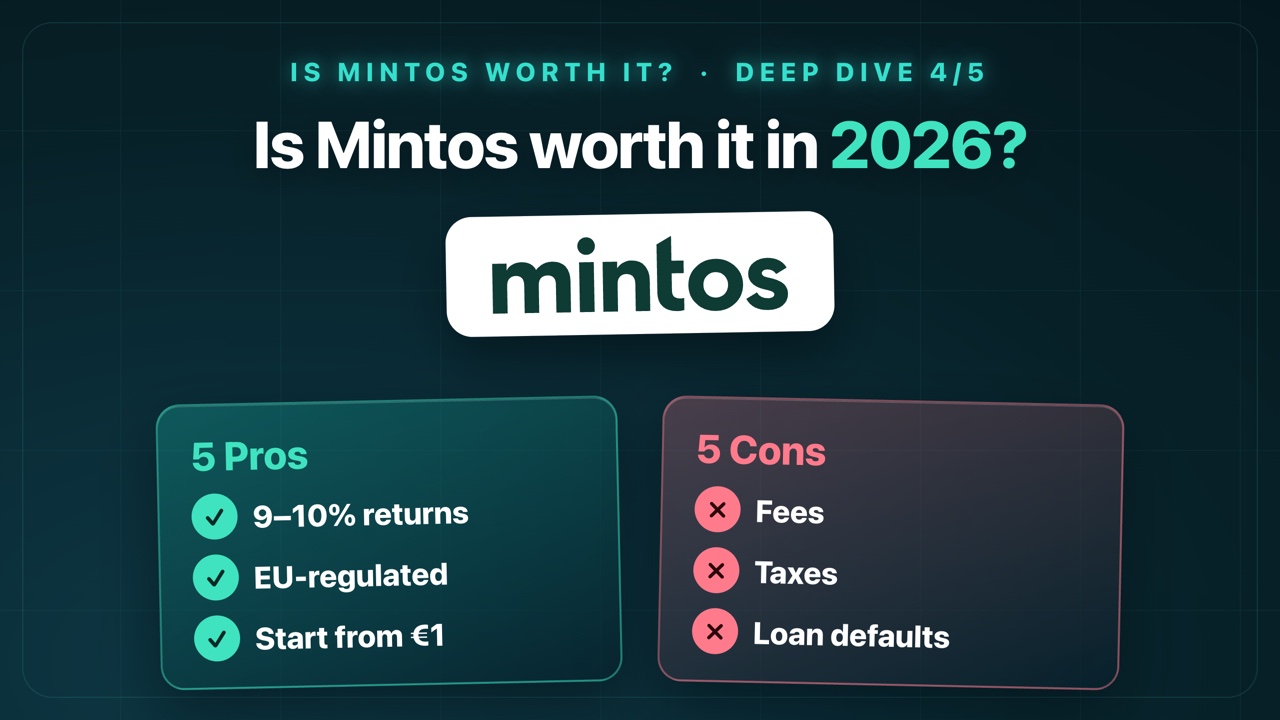
Table of contents
Is it actually still worth investing in Mintos in 2026? That's exactly the question we tackle in part 4 of my Mintos Deep Dive. Over the past few years the platform has evolved from a pure P2P lending marketplace into a genuine multi-asset app – with loans, bonds, real estate, ETFs and even crypto. So today I'll take an honest stock: five advantages, five drawbacks and the question of who Mintos is really worth it for – and who it isn't.
A quick bit of context: I've been invested on Mintos for over five years and have built up a portfolio of more than €13,000 – across loans, bonds, real estate, ETFs and even Mintos shares. So I've lived through the highs and lows and seen quite a bit. As always, the important note: this is not investment advice and not a buy recommendation, but my personal opinion and experience. P2P loans, bonds and crypto are risk investments – a total loss is possible. I'm responsible for my money, you for yours.
What's changed at Mintos in 2026
Before we get to the pros and cons, it's worth looking at what is genuinely new on Mintos* – and quite a lot has happened. The pure P2P platform has become an app in which you can invest in bonds, loans, real estate, ETFs and crypto. That's where the new features sit:
- Crypto ETPs: brand new, you can invest in some cryptocurrencies as ETPs – from €5, in the same portfolio as your other holdings.
- Over 1,000 ETFs from €1: you can now choose yourself from over 1,000 ETFs and invest from as little as €1 – with no order fee. I bought the Vanguard FTSE All-World High Dividend Yield for a few euros just to test it.
- High-Yield Bonds portfolio: bonds now have a fully automated portfolio, similar to Core Loans on the lending side – broadly diversified across many bonds.
- Shares & a banking licence: shares are also on the list, and Mintos is now pursuing a banking licence. The process was opened on 17 February 2026; the share round was carried out partly to fund it.
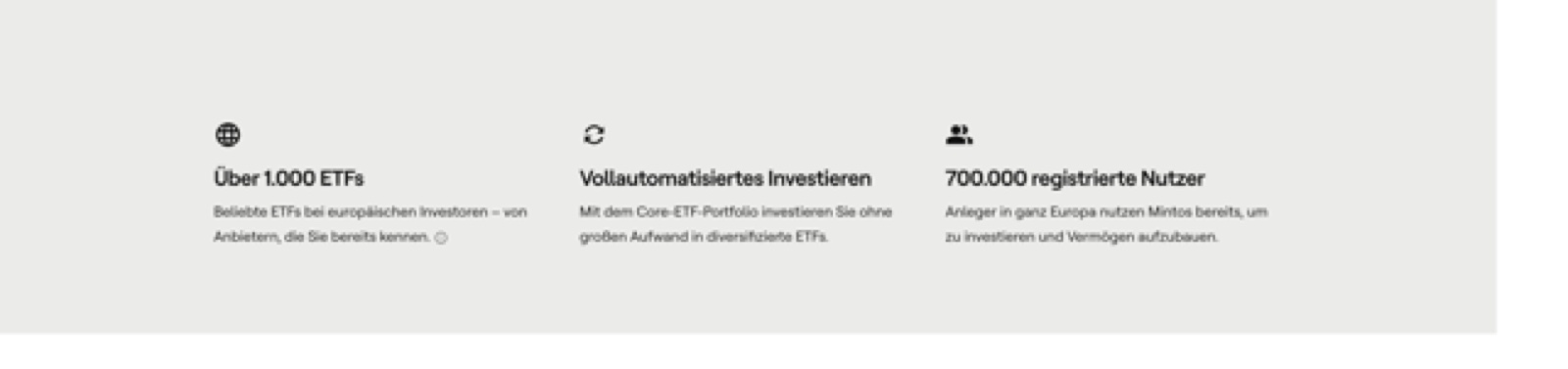
One important caveat right away: with ETFs there is no order fee, but you still pay the spread and the normal ETF costs (TER) of the issuer. "No fees" therefore refers to the Mintos order fee, not to all costs. If you're interested in the individual asset classes in detail, see part 3 on passive income – there I go through each asset class one by one.
My Mintos portfolio today
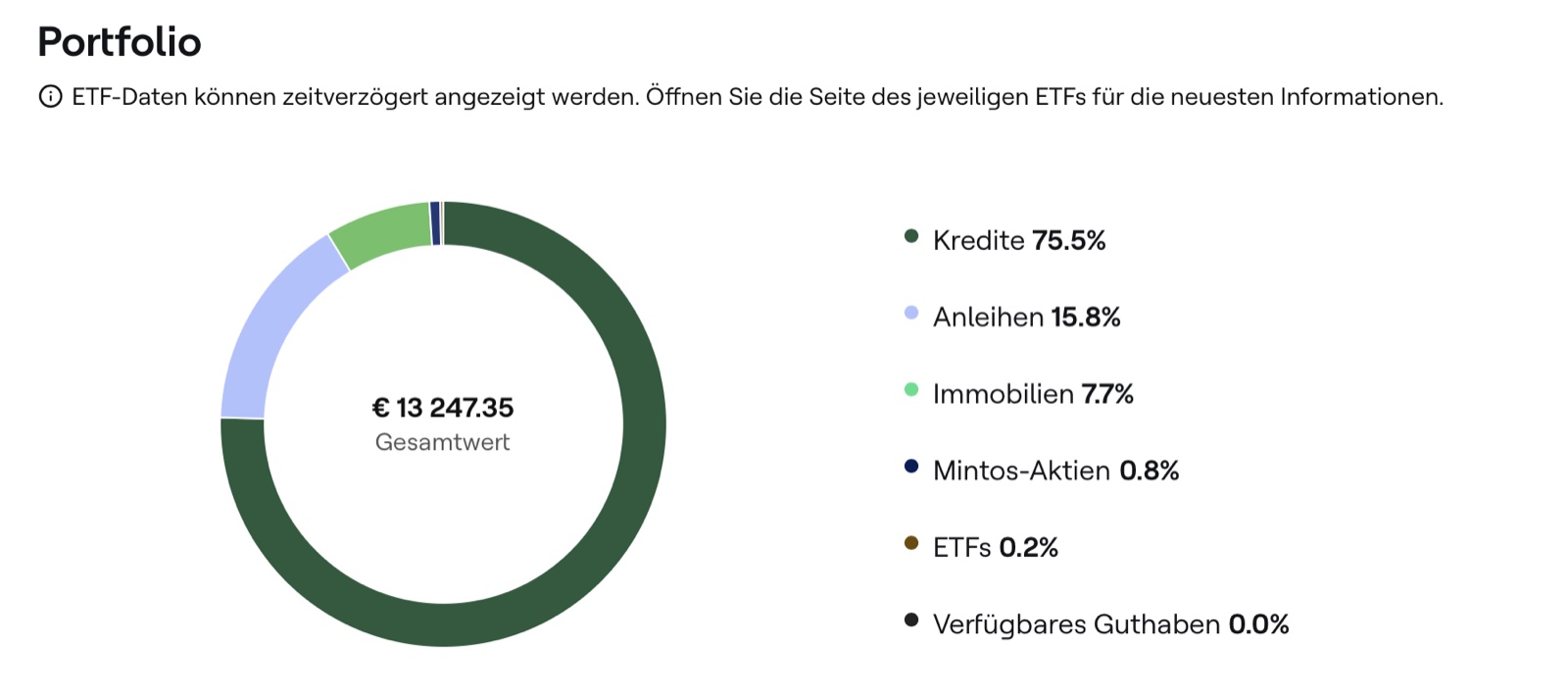
Here's what my own account looks like at the reporting date: €13,247.35, spread across five asset classes – the largest share in loans, plus bonds, real estate and small positions in Mintos* shares and ETFs:
Video: Is Mintos Worth It in 2026? An Honest Look at the Pros and Cons (Deep Dive 4/5)
This is part 4 of my Mintos Deep Dive – in the video I go through the pros and cons one by one and give my personal verdict. Feel free to watch, or read on below.
The 5 big advantages of Mintos
Let's start with the positives. These are the five advantages I genuinely see after more than five years:
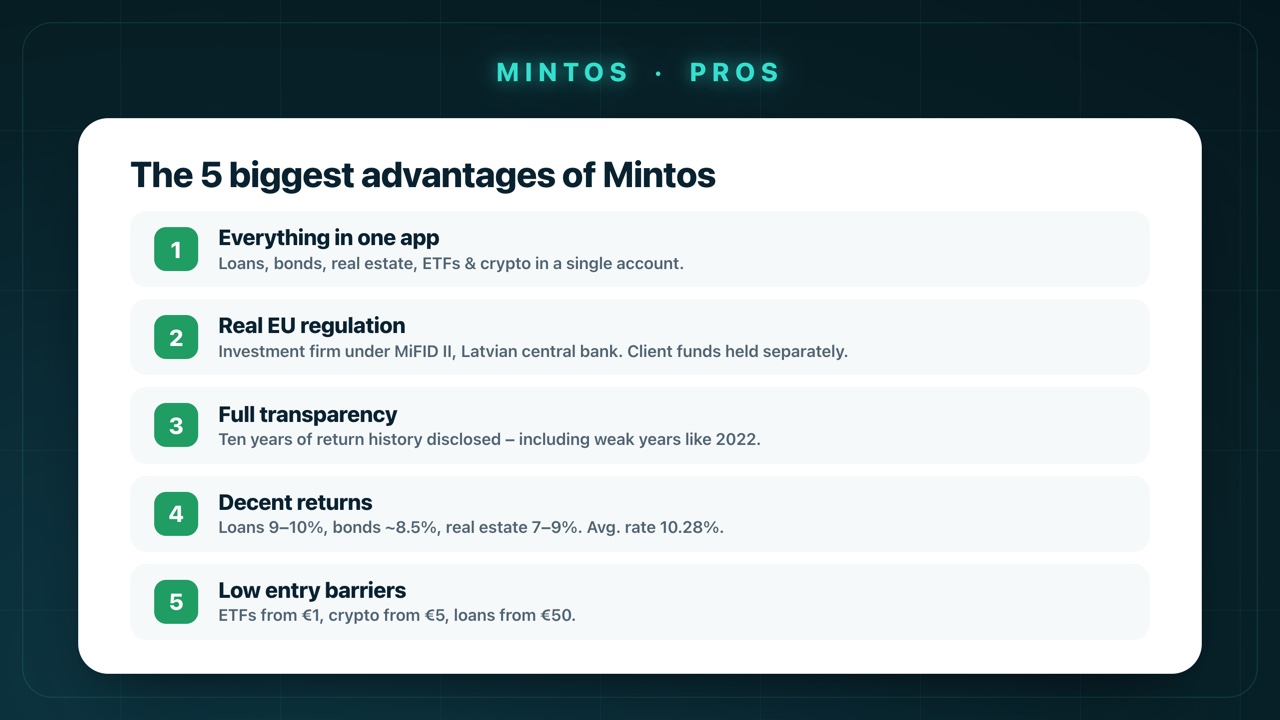
1. Everything in one app. Probably the biggest advantage: you can invest in very different asset classes from a single app – bonds, loans, real estate – and alongside that simply run your world ETF or add a bit of crypto. Hardly any other platform offers this range in one account.
2. Real EU regulation. Mintos* is an investment firm under MiFID II and is supervised by the Latvian central bank. That brings concrete benefits: client funds are held separately from the company's assets, and there is an investor compensation scheme. You'll find all the details in part 2 on safety and regulation.

3. Full transparency. I find this almost more important than the regulation: Mintos discloses its figures openly – over ten years, including the bad ones. Here's the net return on loans since 2015:
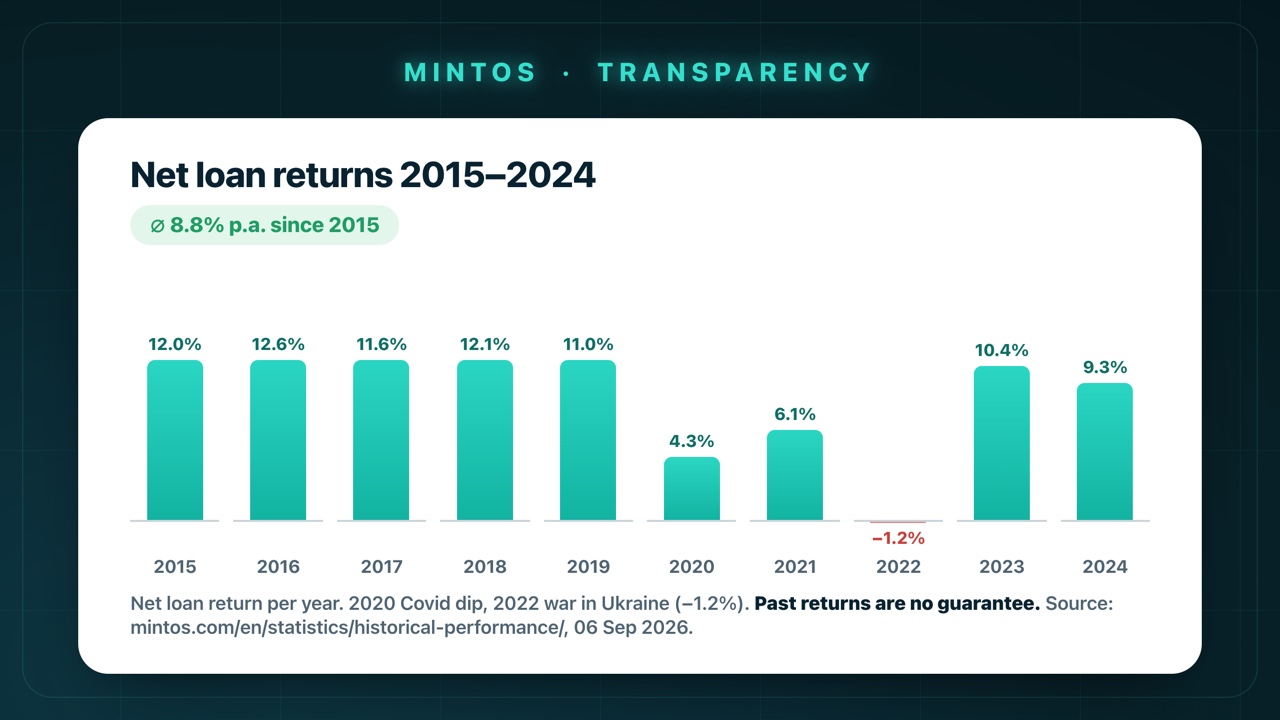
You can see the good years above 12%, but also the Covid dip in 2020 and the crisis year 2022 at −1.2%. The fact that such years aren't hidden but shown openly is exactly what builds trust for me.
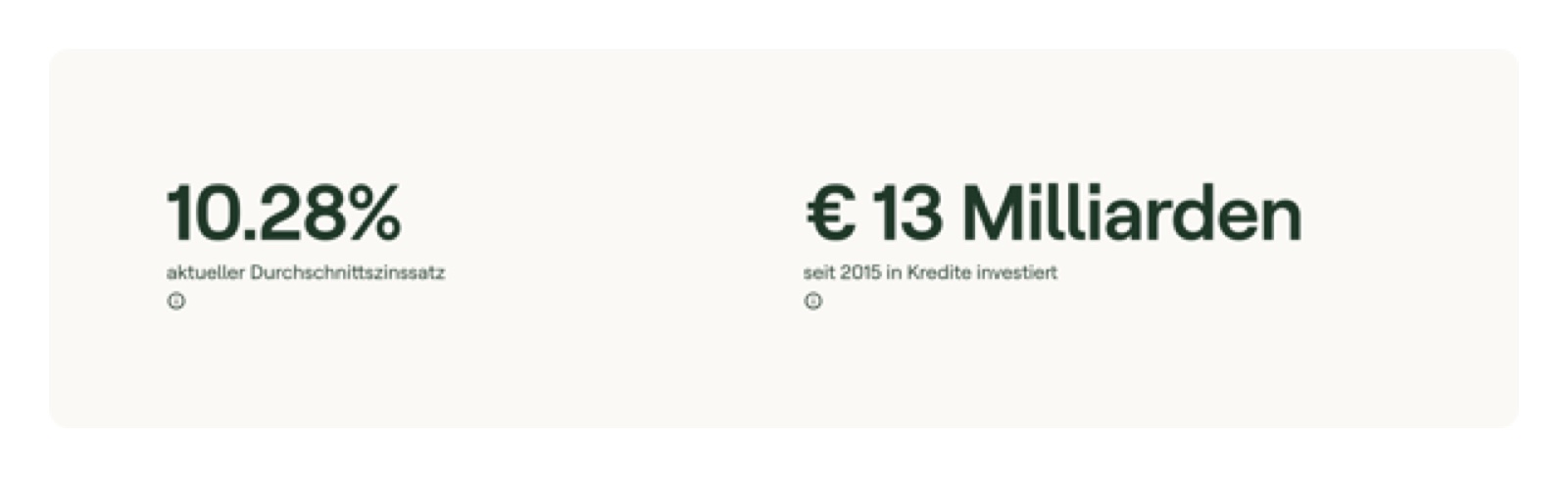
4. Decent returns. On loans I sit somewhere between 9 and 10%, on bonds around 8.5%, on real estate between 7 and 9%. With ETFs and crypto it depends on the market. According to Mintos, the current average interest rate on the loans offered is 10.28%, and over €13 billion has been invested in loans since 2015:
5. Low entry barriers. You don't need a big starting sum: ETFs from €1, crypto from €5, loans and bonds from small amounts. This lets you diversify across several asset classes without putting €1,000 into a single position.
A good moment right now: up to €500 bonus
If you want to try Mintos* yourself, now is a good time: via my link with the code INVEST26 there's currently a tiered welcome bonus of up to €500 – but only until 30 September 2026. After that the maximum is up to €350 (with the code GO-LENNARD).
| Cumulative investment | Bonus |
|---|---|
| from €1,500 | €20 |
| from €2,500 | €35 |
| from €5,000 | €75 |
| from €10,000 | €175 |
| from €25,000 | €500 |
I've summarised all the details, deadlines and eligible products in a separate article: Mintos INVEST26 in detail. For transparency: this is a referral link. If you sign up through it, I receive a small commission – it doesn't cost you more; on the contrary, you secure a bonus you wouldn't otherwise get.
The 5 big drawbacks of Mintos
No investment is without downsides – and I want to be just as honest here. These are the five drawbacks you should know about:
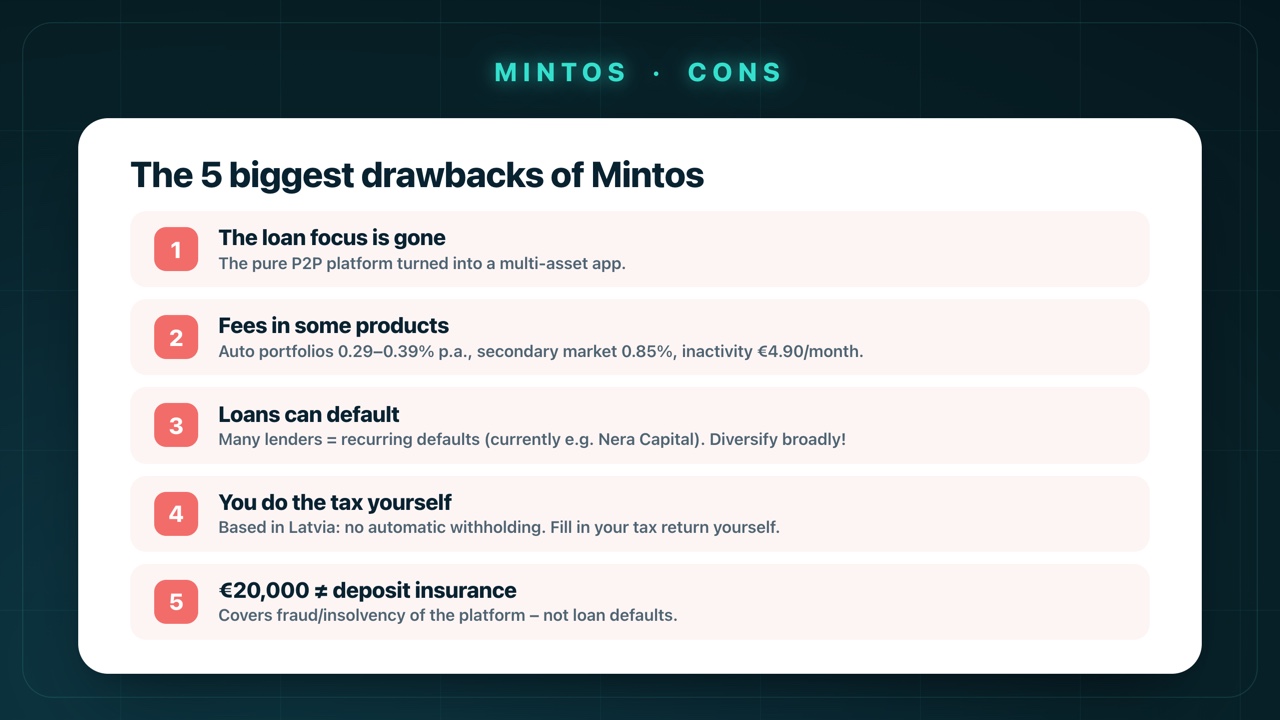
1. The loan focus is gone. Mintos* used to be strongly specialised in P2P loans. Today there's a very broad range. Some people don't like exactly that – and if you really only want to invest in loans, it's easy to lose the overview among so many products. It's a matter of taste, but a legitimate criticism.
2. Fees in some products. The auto portfolios (Core Loans and High-Yield Bonds) carry 0.3 to 0.4% p.a., plus a secondary market fee on sale and an inactivity fee. Everything is described transparently on the website – here are the key rates (as of 09/2026):
| Product | Fee |
|---|---|
| Core Loans | 0.39% p.a. |
| Custom strategy | 0.29% p.a. |
| High-Yield Bonds portfolio | 0.39% p.a. |
| Smart Cash | 0.19% p.a. |
| ETFs & real estate | €0 (no Mintos fee) |
| Sale on the secondary market | 0.85% |
| Inactivity | €4.90 / month |
3. Loans can default. This is the real core risk with P2P: as a marketplace with many lenders, loans do default from time to time. There are currently issues with Nera Capital, for example. On the Mintos statistics page, under "Overdue – ongoing cases", a total of around €184 million is shown as being in recovery from suspended lending companies. That's why the single most important rule applies: diversify broadly – across several platforms and, within Mintos, across many lenders, bonds and properties. Never put 100% of your money into a single loan package, a single bond or a single property.
4. You do the tax yourself. Mintos is based in Latvia, not in your home country. With a domestic broker, taxes are usually forwarded to the tax office automatically – with Mintos that doesn't happen automatically. You do get a simple tax report as a PDF every year, but you have to declare the income yourself – in your tax return or by handing the PDF to your tax adviser. I explained how this works in part 2.
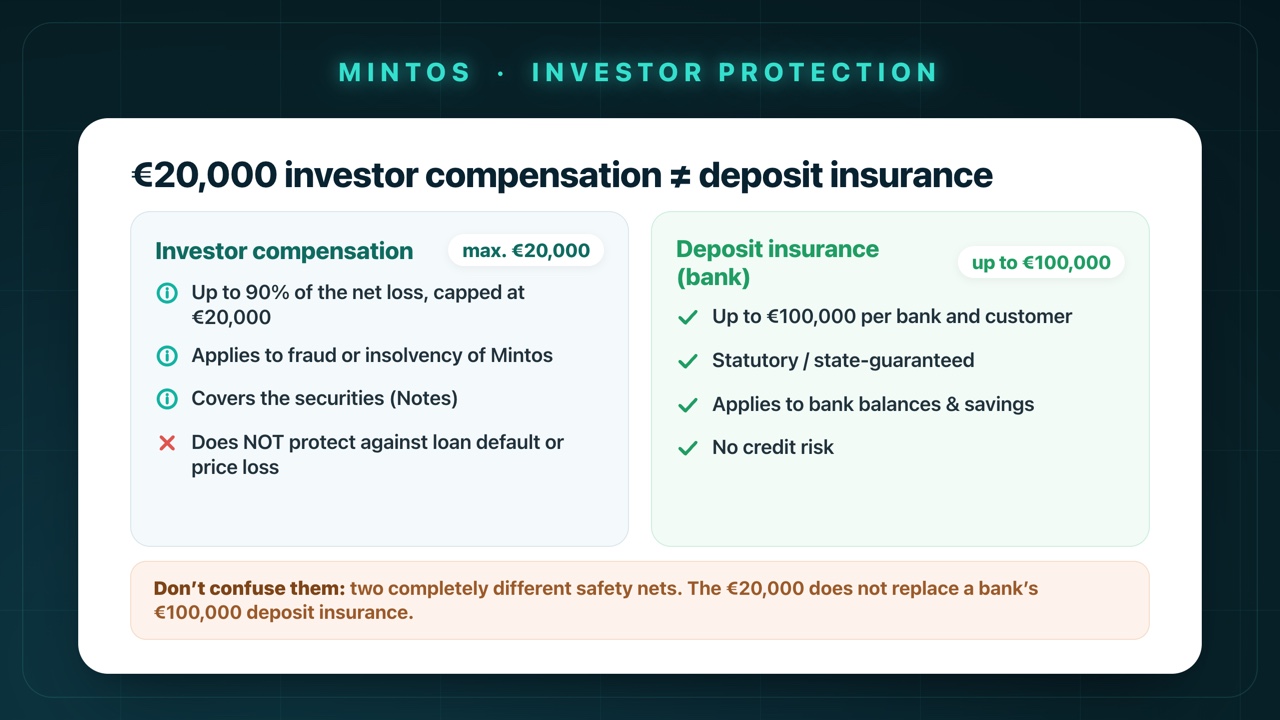
5. €20,000 is not deposit insurance. This is often confused: the €20,000 investor compensation is something completely different from the €100,000 deposit insurance you get with banks and savings accounts. The €20,000 does not protect you against loan defaults or price losses, but rather against fraud or an insolvency of Mintos:
Who is Mintos worth it for in 2026?
Let's get to the actual question. From my point of view, it can be answered fairly clearly:
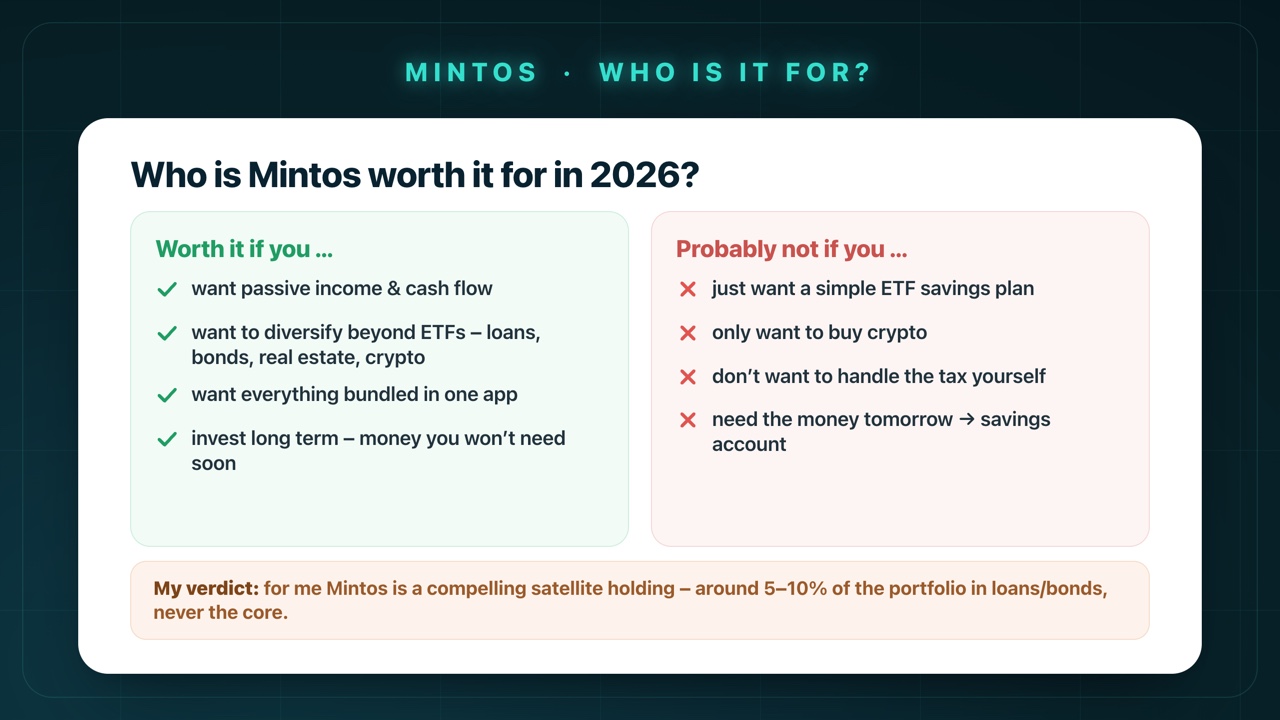
Mintos* is worth it if you want passive income and cash flow, want to diversify beyond ETFs – into loans, bonds, real estate or crypto – and want it all bundled in one app rather than spread across a dozen platforms.
It's probably not worth it if you just want a simple ETF savings plan or only want to buy crypto. For that there are more convenient solutions where the tax runs automatically too. And as a general rule: never invest money you'll need tomorrow here – a savings account is the safer choice for that.
My verdict
Is Mintos* worth it in 2026? For me: yes – but as a satellite holding, not the core. I think it's a great addition to my portfolio and I'm genuinely well diversified there across loans, bonds, real estate and a little ETFs. The combination of one app, EU regulation, real transparency and decent returns has convinced me for over five years. At the same time, the drawbacks are real: loans default, the tax doesn't run automatically, and the €20,000 is not all-round protection. If you're aware of those risks, Mintos can be a compelling satellite holding – for me, around 5–10% of the portfolio in loans and bonds, but never more.
That was part 4 of the Deep Dive. If you missed the other parts: in part 1 I show my complete Mintos portfolio, part 2 is about safety, regulation and taxes and part 3 is about passive income. In the next and final part it's all about how to spread risk and diversify with Mintos.
Now I'm curious about your view: is Mintos worth it for you – and what experiences have you had? Feel free to share them in the comments. You'll find all current P2P promotions bundled in my P2P bonus overview.
Frequently asked questions
Is Mintos still worth it in 2026?
For me, yes – but as a satellite holding, not the core of the portfolio. Mintos bundles loans, bonds, real estate, ETFs and crypto in one EU-regulated app, discloses ten years of return history (avg. 8.8% p.a. since 2015) and lets you start from as little as €1. Against that stand real drawbacks: the lost loan focus, fees in some products, loan defaults, doing your own tax and the investor compensation capped at €20,000. Important: this is not investment advice, P2P is a risk investment and a total loss is possible.
What are the biggest advantages of Mintos?
Five points: 1) Everything in one app – loans, bonds, real estate, ETFs and crypto in a single account. 2) Real EU regulation as an investment firm under MiFID II, supervised by the Latvian central bank. 3) Full transparency – Mintos publishes ten years of return history, including weak years like 2022 (−1.2%). 4) Decent returns: loans 9–10%, bonds around 8.5%, real estate 7–9%. 5) Low entry barriers from €1 (ETFs), €5 (crypto) or €50 (loans).
What are the biggest drawbacks of Mintos?
Five honest points: 1) The original focus on P2P loans has given way to a broad multi-asset offering. 2) Some products carry fees (auto portfolios 0.29–0.39% p.a., secondary market 0.85%, inactivity €4.90/month). 3) Loans can default – there are currently issues with Nera Capital, for example. 4) You have to handle the tax yourself because Mintos is based in Latvia. 5) The €20,000 investor compensation is not a €100,000 deposit insurance.
What is the average return on Mintos?
Mintos reports an average net annual return on loans of around 8.8% since 2015. The current average interest rate on the loans offered is 10.28%. The individual years vary widely: from over 12% in the early years, to 4.3% in the Covid year 2020, down to −1.2% in the crisis year 2022. In 2023 it was 10.4%, in 2024 around 9.3%. Past returns are no guarantee of future results.
What's happening with Nera Capital on Mintos?
Nera Capital is one of the lending companies currently facing problems. On mintos.com, under 'Overdue – ongoing cases', a total of around €184 million is shown as being in recovery from suspended lending companies. This illustrates the biggest P2P risk: as a marketplace with many lenders, loans do default from time to time. That's why broad diversification – across platforms and within the platform – matters so much.
Does the €20,000 compensation protect my money on Mintos?
Only partly. The investor compensation covers up to 90% of the net loss, capped at €20,000, and applies in cases of fraud or insolvency of Mintos. It does NOT protect against loan defaults or price losses – that's the normal investment risk. It is also something completely different from the statutory €100,000 deposit insurance that applies to bank balances and savings accounts. Please don't confuse the two.
Who is Mintos worth it for – and who isn't it for?
Mintos is worth it above all if you want passive income, want to diversify beyond ETFs (into loans, bonds, real estate, crypto) and want everything bundled in one app. It's probably not worth it if you just want a simple ETF savings plan or only want to buy crypto – for German investors there are more convenient solutions with automatic tax handling for that. And: never invest money you'll need tomorrow – a savings account is the safer choice for that.
Disclaimer
⚠️ Not investment advice
All content is for information and entertainment purposes only and does not constitute investment advice, a buy recommendation or an invitation to enter into a financial product. Please do your own research and make decisions based on your personal situation and risk tolerance.
📉 Risk warning & total loss
Investments in securities and other financial instruments generally carry significant risks (e.g. price, market, currency, volatility and credit risks). A total loss of the capital invested cannot be ruled out.
📊 Returns & forecasts
All performance figures, whether historical or as a forecast/estimate, are not a reliable indicator of future results. Capital and returns are not guaranteed.
🔍 Transparency & conflicts of interest
I strictly distinguish between facts and personal estimates. Important: I am often invested in the assets discussed myself, which can create a conflict of interest.
✅ DYOR (Do Your Own Research)
All information has been compiled carefully but is non-binding, without warranty and without any claim to completeness. Please inform yourself thoroughly and consider all opportunities and risks in depth before making an investment decision.
Advertising & affiliate notice
Links marked with * are advertising or affiliate links. If you sign up or buy something through such a link, I may receive a commission – at no extra cost to you. This supports my work.