Revest Review 2026: The New Secondary Market Is Here – My Test (13.5–16% Interest, Buyback)
My Revest review with the big update: Revest has finally launched a secondary market – early exits are now possible. I show how the secondary market works, how this Robocash-style platform from Croatia with Kazakh loans, 13.5–16% interest and a buyback guarantee ticks, where it stands on regulation, which risks remain – and my own position: €1,250.80 at 15.13% yield, just topped up by €250.
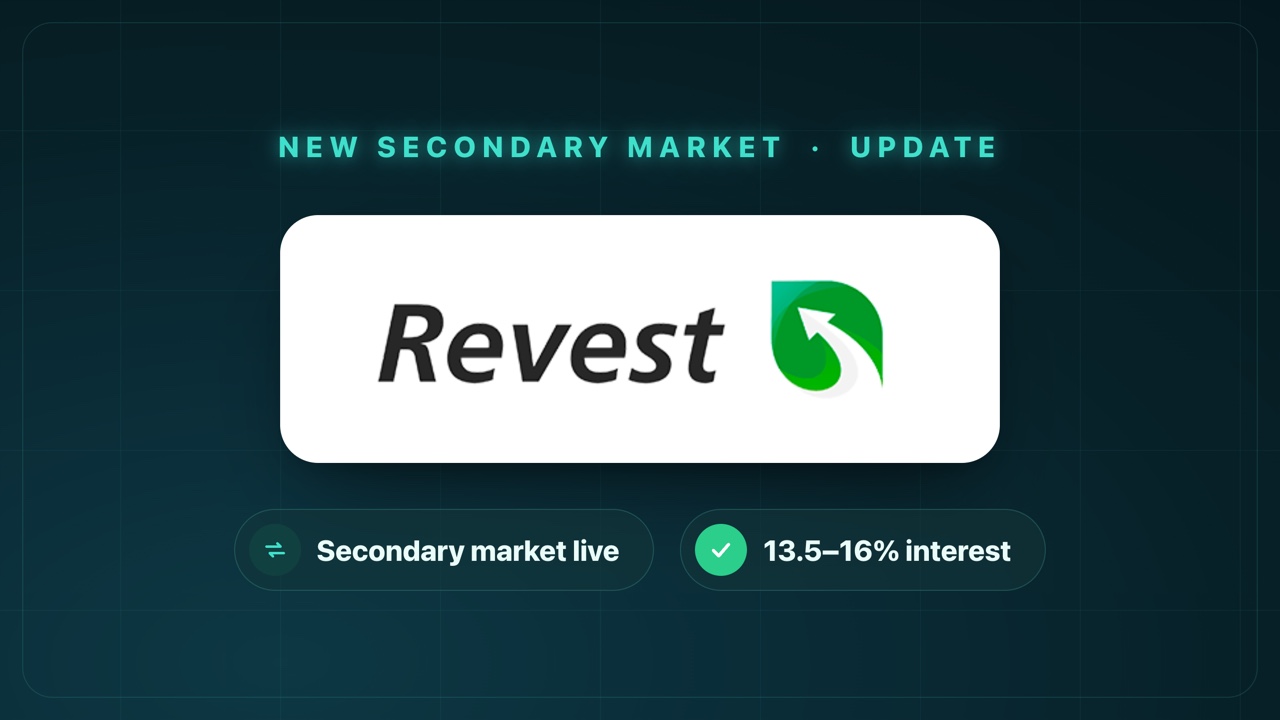
Table of contents
- Revest at a glance
- What is Revest?
- Video
- Is Revest regulated and safe?
- Interest, terms and products
- The big update: Revest now has a secondary market
- The buyback guarantee: protection with an asterisk
- Fees
- My Revest experience: where I stand today
- Taxes on Revest
- The Revest bonus: up to 6% cashback
- Is Revest worth it?
- Conclusion: who is Revest right for?
- FAQ
Since the beginning of August I've been investing on Revest* – I started with a small test position of around €1,000, it's now €1,250.80, and I've just topped it up by another €250. But the reason for this update is a different one: Revest has finally launched a secondary market. The platform's biggest drawback – that your money was locked until maturity – is gone. In this post I'll walk you through the platform: how the new secondary market works, how this Robocash-style alternative from Croatia with Kazakh loans ticks, where it stands on regulation, buyback and taxes, how to get the bonus – and where the honest weak spots are.
As always, the most important note up front: this is not investment advice and not a buy recommendation. I only show my personal investments and my personal opinion. I'm responsible for my money, you for yours – especially in P2P and credit investing the risks are significant, up to total loss. Do your own research and always make your own decision.
Revest at a glance
If you're short on time, here's the short version:
- What: a P2P platform for buying loan claims, operated by FINTECH PLATFORM d.o.o. from Pula (Croatia).
- Loans: from lenders in Kazakhstan around the GMoney/Unicredo group (including MoneyPlus, GM Aurora, GM Group).
- Model: a classic Robocash alternative – high interest, short terms, a buyback guarantee.
- Interest: around 13.5% (consumer loans) to 14.5% (business loans), up to 16% at the top end.
- Terms: approx. 30 days (consumer) to 3–24 months (business), some with monthly interest payments.
- Entry: from €10, no investor fees, no foreign withholding tax.
- New: a working secondary market – early exits are now possible.
- Protection: a buyback guarantee on overdue claims – but no EU regulation, no deposit insurance.
- My position: €1,250.80, displayed yield 15.13%, just topped up by €250.
- Bonus: currently up to 6% cashback – tiered by maturity, campaign until 30 Sept 2026 – via my partner link*.
What is Revest?
Revest* is a P2P platform through which you invest in loan claims: you buy shares in loans issued by lenders in Kazakhstan, and you earn on the interest the borrowers pay. The platform is operated by FINTECH PLATFORM d.o.o., based in Pula, Croatia. The loans themselves come from around the GMoney group (including Unicredo, MoneyPlus, GM Aurora, GM Group).
In principle, Revest is a Robocash alternative: high double-digit interest, short terms, a buyback guarantee and a lender that comes from within its own corporate group. If you know Robocash, Lendermarket or Esketit, you'll find your way around quickly. That's both a blessing and a curse: attractive terms on one hand – but also a young, unregulated provider with clear concentration risk on one country and one credit group. That's exactly why, with Revest, I look especially closely at regulation, protection and diversification.
Video: Revest Review 2026: The New Secondary Market Is Here – My Test (13.5–16% Interest, Buyback)
The full update is also available as a video – I walk live through my Revest portfolio and the brand-new secondary market. Have a look or read on below.
Is Revest regulated and safe?
Honestly and without beating around the bush: Revest is not EU-regulated. There's no ECSP licence like Afranga and no MiFID II licence like TWINO. Regulation only applies to lending at the lender level – Unicredo holds a Kazakh lending licence. For you as an investor that means:
- No deposit insurance, no investor compensation scheme – Revest is not a bank.
- No EU supervision of the platform itself, no standardised investment information sheets as under the ECSP regulation.
- Your most important protection is the buyback guarantee (more on that below) – plus the selection and creditworthiness of the lender.
On top of that there's a point that often gets overlooked with Kazakh loans: currency risk. The loans are ultimately tied to the Kazakh tenge. Exchange-rate moves and the local economic situation can add another layer of influence. For me, Revest is therefore clearly a high-yield bet with elevated risk – interesting as a small addition, but not somewhere I'd park a large chunk of my capital.
Interest, terms and products
The terms are the reason Revest is interesting in the first place:
| Consumer loans | Business loans | |
|---|---|---|
| Interest | around 13.5% p.a. | around 14.5% p.a. (up to 16%) |
| Term | approx. 30 days | 3–24 months |
| Interest payment | at the end of the term | partly monthly, partly at the end |
| Buyback guarantee | yes, on default | yes, on default |
| Minimum | from €10 | from €10 |
The short terms on consumer loans are a real advantage: your capital is never locked up for long, and interest plus principal flow back quickly and can be reinvested. For a hands-off setup there's an Auto Invest that automatically invests your money into matching claims (including the secondary market, see below) based on your criteria. Also new is the option for claims with monthly interest payments – handy if you like a regular income stream instead of waiting until the end of the term.
The big update: Revest now has a secondary market
Revest's biggest drawback for a long time was the lack of liquidity: once invested, your money was locked until maturity. That's over now – Revest has launched a secondary market where you can sell active claims early to other investors. That's also the focus of the video. Here's how the secondary market works right now:
- Price: sales happen at the remaining nominal value – with no premium or discount. Markups and discounts based on supply and demand are set to become possible later, according to Revest.
- Interest: as the seller you receive the interest accrued up to the sale date. The buyer takes over the claim at the original interest rate and earns from the purchase date onwards.
- Only healthy claims: only active, non-overdue loans can be listed. Overdue claims are excluded.
- No partial sales: the buyer always takes over the entire claim, not just a part.
- Purchase via Auto Invest: buyers pick up listings via their Auto Invest – if you want to buy secondary-market offers automatically, you set that up there with the same criteria as on the primary market.
- No guaranteed exit: you can withdraw a listing as long as no buyer has been assigned. But a sale is only certain once a buyer actually shows up.
For me this is a real step forward. Even though the short terms at Revest already soften the "money is locked" problem, the secondary market now gives you an additional emergency exit if you want out earlier. The model is clearly modelled on Robocash. Realistically, though: how lively the market really is – i.e. how quickly you find a buyer – will only become clear over time and with a growing user base.
The buyback guarantee: protection with an asterisk
Revest's central safety feature is the buyback guarantee. If a claim falls overdue, the lender repurchases it including accrued interest. It's the same principle as Robocash or Lendermarket and takes a lot of the sting out of small individual defaults.
But – and this is important – the buyback guarantee is not a bank guarantee and not state protection. It's only as strong as the solvency of the lender behind it. As long as the GMoney/Unicredo group is healthy, the mechanism works. If the lender itself runs into trouble, the buyback guarantee is worth little – and then exactly the risks (concentration risk, no regulation) I described above come into play. That's precisely why broad diversification across several platforms is essential for me, rather than betting too much on a single high-yield platform.
Fees
The good news to round off the facts: Revest is free for investors – registration, investing and deposits/withdrawals cost nothing. There are currently no selling fees on the secondary market either. The platform earns on the margin between lender and investor, not directly from you.
My Revest experience: where I stand today
I document my Revest* investment transparently. I started at the beginning of August with around €1,000 as one of three new test platforms (alongside Silvaland and 7Harvests). It's now at €1,250.80, the displayed yield is 15.13%, and I've just topped it up by another €250 – partly to test the new secondary market properly.
My takeaway after the first few weeks: the short terms and the buyback guarantee make Revest pleasantly low-maintenance day to day, and the fresh secondary market is exactly the feature the platform was still missing. Even so, Revest deliberately stays a small position for me. As with my P2P portfolio in general, my rule applies: cap unregulated, young high-yield platforms carefully and diversify broadly across many providers, rather than chasing the highest number.
Taxes on Revest
One pleasant point: no foreign withholding tax is deducted on Revest interest. So more gross interest is left over than with, say, Bulgarian (10%) or Latvian (5%) platforms, where a share is withheld at source.
As with all foreign platforms, you report and pay German withholding tax yourself via Anlage KAP in your tax return – there's no automatic deduction. Keep the annual statement from your Revest account for that. (This is not tax advice – if in doubt, ask your tax advisor.)
The Revest bonus: up to 6% cashback
If you want to test Revest yourself: there's currently a cashback campaign of up to 6% – tiered by maturity. The longer the claim, the higher the cashback:
| Maturity | Cashback |
|---|---|
| 25 days | 0.25% |
| 1 month | 0.25% |
| 3 months | 1.50% |
| 6 months | 2.50% |
| 12 months | 4.00% |
| 24 months | 6.00% |
Cashback is calculated per claim and paid out as a lump sum after the campaign ends. The campaign runs from 10 Aug to 30 Sept 2026. Via my partner link* your registration is tracked automatically, no code needed.
Worth keeping in mind: the full 6% only applies to the long 24-month claims – the short consumer loans earn correspondingly less. Always double-check the exact conditions and how much time is left on the campaign directly at Revest before signing up.
Who is Revest right for?
- want high interest of 13.5–16% with short terms
- want a buyback guarantee on overdue claims (Robocash principle)
- want to use the new secondary market for early exits
- want to invest with no investor fees and no foreign withholding tax – from as little as €10
- understand the risks of unregulated credit investments and only invest spare capital
- expect EU regulation (ECSP/MiFID II) or deposit insurance – there is none here
- won't accept concentration risk on one country (Kazakhstan) and one credit group (GMoney)
- don't want currency risk via the Kazakh tenge
- need a guaranteed, instant exit like a savings account
- want a large, broadly diversified platform with a long track record
Conclusion: who is Revest right for?
Revest is a typical high-yield P2P platform with everything that comes with it – for better and for worse. The terms are strong: 13.5–16% interest, short terms, a buyback guarantee, no fees, no withholding tax, currently up to 6% cashback – and with the new secondary market, its biggest drawback is now gone too. For risk-aware investors who like the Robocash model and diversify broadly, it's an interesting building block.
At the same time, don't ignore the flip side: no EU regulation, a clear concentration risk on Kazakhstan and the GMoney group, currency risk via the tenge, and protection that hangs on the solvency of a single lender. For me that means: an interesting but small test position – and never money whose total loss I couldn't handle.
If you'd like to try Revest, grab the up to 6% cashback via my partner link* (campaign until 30 Sept 2026). And if you want to see how Revest fits into the bigger picture: my full P2P portfolio is publicly viewable, and all current promotions are bundled at finlen.de/p2pbonus.
Links marked with * are partner links. If you start through them, you support my work – nothing changes for you; on the contrary, you secure the cashback. Thank you!
Frequently asked questions
What is Revest and who is behind it?
Revest is a P2P platform operated by FINTECH PLATFORM d.o.o. from Pula (Croatia). You buy shares in loan claims from lenders in Kazakhstan – mainly around the GMoney/Unicredo group (including MoneyPlus, GM Aurora, GM Group). In terms of its model, Revest is a classic Robocash alternative: high interest, a buyback guarantee and short terms.
Is Revest regulated and safe?
No, Revest itself has no EU financial licence such as ECSP or MiFID II regulation. Regulation only applies to lending at the lender level: Unicredo holds a Kazakh lending licence. There is no deposit insurance and no investor compensation scheme. Your protection is the buyback guarantee on overdue claims – but that is only worth as much as the paying capacity of the lender behind it. The credit risk stays 100% with you.
How high is the interest on Revest?
Consumer loans pay around 13.5% per year, business loans about 14.5%, and the platform advertises up to 16% at the top end. Terms range from around 30 days (consumer loans) to 3–24 months (business claims). There are now also claims with monthly interest payments. In my own portfolio the displayed yield currently sits at 15.13%.
Does Revest have a secondary market now?
Yes – and that's the big update. Revest has launched a secondary market where you can sell active claims early. For now, sales happen at the remaining nominal value with no premium or discount; you receive accrued interest up to the sale date, and the buyer takes over the claim at the original interest rate and earns from the purchase date. Buyers pick up listings via their Auto Invest. Only active, non-overdue claims can be listed, partial sales aren't possible, and a sale is only certain once a buyer is found.
What does the Revest buyback guarantee do?
If a claim falls overdue, the buyback guarantee kicks in: the lender repurchases the overdue claim including accrued interest. It's the same principle as Robocash or Lendermarket and takes a lot of the sting out of individual defaults. Important: the guarantee is not a bank guarantee and not state protection – it only works as long as the lender is solvent. If the lender fails, the buyback guarantee is worth little.
What taxes apply on Revest?
No foreign withholding tax is deducted on Revest interest – so more gross interest is left over than with, say, Bulgarian or Latvian platforms. You report and pay German withholding tax yourself via Anlage KAP; there's no automatic tax deduction. (Not tax advice – check with your tax advisor if in doubt.)
How does the Revest bonus work?
There's currently a cashback campaign of up to 6% – tiered by maturity: 0.25% for 25 days, 1.5% for 3 months, 2.5% for 6 months, 4% for 12 months and 6% for 24 months. Cashback is calculated per claim and paid out as a lump sum after the campaign ends. The campaign runs from 10 Aug to 30 Sept 2026; it's tracked automatically via my partner link, with no code.
Who is Revest right for, and what are the risks?
Revest fits if you want high interest (13.5–16%), short terms, a buyback guarantee and now a secondary market too, and you understand the risks. The biggest risks: no EU regulation, heavy concentration risk on Kazakhstan and the GMoney group, currency risk (the loans are tied to the Kazakh tenge), and dependence on the lender's solvency. Only invest money you could afford to lose entirely – for me, Revest deliberately stays a small test position.
Disclaimer
⚠️ Not investment advice
All content is for information and entertainment purposes only and does not constitute investment advice, a buy recommendation or an invitation to enter into a financial product. Please do your own research and make decisions based on your personal situation and risk tolerance.
📉 Risk warning & total loss
Investments in securities and other financial instruments generally carry significant risks (e.g. price, market, currency, volatility and credit risks). A total loss of the capital invested cannot be ruled out.
📊 Returns & forecasts
All performance figures, whether historical or as a forecast/estimate, are not a reliable indicator of future results. Capital and returns are not guaranteed.
🔍 Transparency & conflicts of interest
I strictly distinguish between facts and personal estimates. Important: I am often invested in the assets discussed myself, which can create a conflict of interest.
✅ DYOR (Do Your Own Research)
All information has been compiled carefully but is non-binding, without warranty and without any claim to completeness. Please inform yourself thoroughly and consider all opportunities and risks in depth before making an investment decision.
Advertising & affiliate notice
Links marked with * are advertising or affiliate links. If you sign up or buy something through such a link, I may receive a commission – at no extra cost to you. This supports my work.